Now readingIntroduction
0%
AP Macroeconomics · Framework 2026-27
Unit 6

Open Economy—International Trade and Finance

Unit 6 uses consistent signs and currency units to connect the balance of payments, foreign-exchange equilibrium, net exports, and international capital flows.

Exam weight
10–13%
Topics
6
demand for currencysupply of currency
Currency prices balance supply and demandA downward-sloping currency-demand curve crosses an upward-sloping currency-supply curve. Both axes name the modeled currency and quote convention so appreciation and depreciation have an unambiguous direction.

Introduction

Unit 6 uses consistent signs and currency units to connect the balance of payments, foreign-exchange equilibrium, net exports, and international capital flows.

A current-account balance is paired with an offsetting capital and financial balance in the simplified AP ledger. The transaction behind an entry matters: a good, service, income payment, transfer, or asset purchase belongs in a different place even when the same currency changes hands.

In foreign exchange, the vertical axis is the price of one named currency in units of another. Relative returns, income, inflation, preferences, and expectations shift currency demand or supply; the resulting appreciation or depreciation feeds back into net exports and aggregate demand.

01
International transaction

current or capital/financial account

02
Currency demand and supply

exchange-rate equilibrium

03
Relative economic conditions

currency shifts

04
Currency value

net exports and aggregate demand

05
Relative real returns

capital flows and account balances

Current exam guidance: Aligned to the current 2026–27 AP Macroeconomics framework. Models identify their axes, assumptions, time horizon, movement or shift, and quantitative consequence.
6.1

Balance of Payments Accounts

How do trade and financial flows balance in an international ledger?

Short answer

The current account records goods, services, income, and transfers, while the combined capital and financial account records asset flows; in the simplified AP convention, CA+CFA=0CA+CFA=0.

Know firstNet exports · National saving and investment · Credits and debits

Classify the transaction before assigning its sign

Exports, income received from abroad, and transfers received are current-account credits; imports, income paid abroad, and transfers sent are debits. Cross-border purchases and sales of assets enter the combined capital and financial account. A domestic asset sold to a foreign buyer brings a financial inflow and is positive under the convention used here.

In the synthetic ledger, exports are 18, imports are 30, and net other current receipts are 2, so CA=18−30+2=−10CA=18-30+2=-10. A net capital and financial inflow of 10 balances the simplified identity. This does not mean every real release sums exactly to zero: statistical discrepancies, valuation, and separately reported capital and financial categories must be respected. A current-account deficit is also not a government budget deficit. It describes international transactions, not fiscal policy.

Economic model

Current and capital-financial accounts

Classify international flows and verify the simplified balance identity.

Held constant
The AP combined capital-and-financial-account convention is used; statistical discrepancy and valuation changes are omitted.
Time horizon
One accounting period.
Read the change
This is an accounting ledger, not a curve-shift model; reverse every transaction and both account signs reverse.
Current account
−10
Capital/financial account
+10
Simplified balance
0
Account balance
Current and capital-financial accountsExports of 18, imports of 30, and other current receipts of 2 produce a current-account deficit of 10. A financial inflow of 10 offsets it.
Horizontal axis
Account
Vertical axis
Balance (currency units per period)
CA+CFA=0CA+CFA=0

Exports of 18, imports of 30, and other current receipts of 2 produce a current-account deficit of 10. A financial inflow of 10 offsets it.

Read the model as a table
Current and capital-financial accounts values
EntryAccountCredit/debitValue
exportscurrentcredit18
importscurrentdebit-30
net income/transfers receivedcurrentcredit2
net asset inflowcapital and financialcredit10
totalallbalanced0
Economy in context
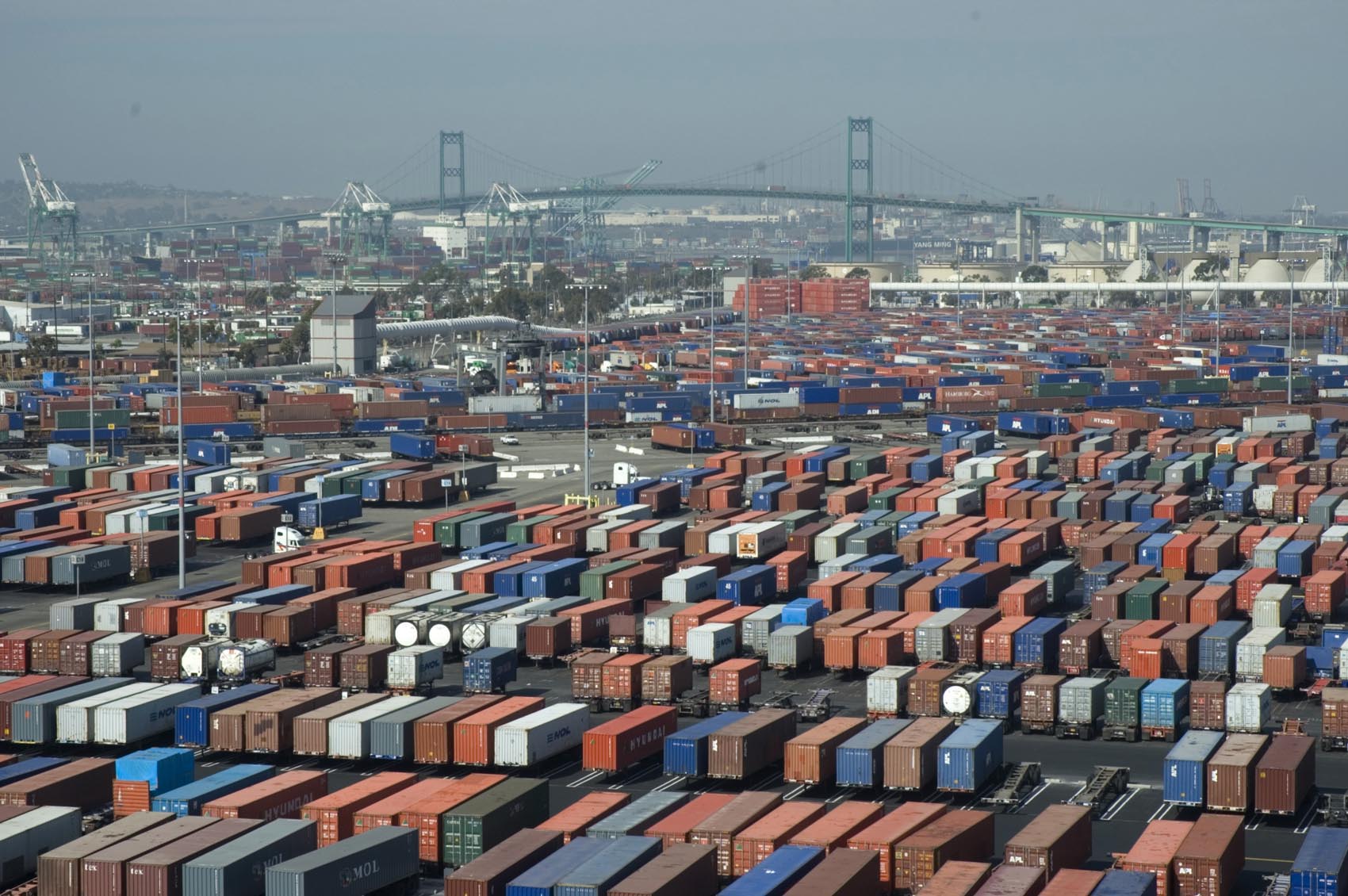
Elevated view across stacked shipping containers, cargo cranes, and the Vincent Thomas Bridge at the Port of Los Angeles and Long Beach in 2006.

Visible trade is only part of the balance of payments

Imported and exported goods enter the current account, while the financial claims used to settle international transactions enter the capital and financial account under the course convention.

Use this visual to see
Begin with observable goods trade, then connect it to the less visible financial entry that completes the accounting record.
What it cannot show
The port view does not identify exports versus imports, service trade, investment income, transfers, financial flows, or account signs.

Enter a transaction once on each side of the world ledger

  1. Identify whether the transaction is a good, service, income, transfer, or asset.
  2. Place it in the current or capital/financial account.
  3. Assign the credit or debit sign using the stated convention.
  4. Find the offsetting payment or asset entry.
  5. Check that the simplified aggregate balances sum to zero.

Keep these three ideas

  • The current account records trade, income, and transfers.
  • Asset flows enter the capital and financial account.
  • In the simplified ledger, CA+CFA=0CA+CFA=0.

Keep reading Unit 6: Open Economy—International Trade and Finance

You just read the first topic free. Your free trial opens the rest of this unit, every AP Macroeconomics unit, and all 19 AP courses.

  • 6.1 Balance of Payments AccountsRead
  • 6.2 Exchange Rates
  • 6.3 The Foreign Exchange Market
  • 6.4 Effect of Changes in Policies and Economic Conditions on the Foreign Exchange Market
  • 6.5 Changes in the Foreign Exchange Market and Net Exports
  • 6.6 Real Interest Rates and International Capital Flows
Start my free 7 days →$0.00 due today · cancel anytime · score guarantee

Practice AP Macroeconomics in the real test engine.

Free practice set: timed, the same engine as our full-length tests, every answer explained.