Production, Cost, and the Perfect Competition Model
A firm compares marginal benefit with marginal cost, but the correct decision also depends on the time horizon: fixed inputs shape short-run production, avoidable costs shape shutdown, and all costs matter for long-run entry and exit.
- Exam weight
- 22–25%
- Topics
- 7
Introduction
A firm compares marginal benefit with marginal cost, but the correct decision also depends on the time horizon: fixed inputs shape short-run production, avoidable costs shape shutdown, and all costs matter for long-run entry and exit.
Short-run production holds at least one input fixed. As variable input is added, specialization may initially raise marginal product, but crowding a fixed input eventually lowers it. When the variable input has a constant price, that falling marginal product appears as rising marginal cost.
A firm maximizes profit at the output where the last unit adds at least as much revenue as cost and the next unit would not. Profit can still be negative there. Competitive entry and exit then connect one firm’s decision to the market without treating market quantity and firm quantity as the same scale.
marginal product
marginal cost
economic profit
profit-maximizing output
produce, shut down, enter, or exit
competitive firm demand
The Production Function
How does adding labor change output when another input is fixed?
Total product rises by each worker’s marginal product; diminishing marginal returns begins when that added output starts falling, even while total output continues to rise.
Total product can rise while marginal product falls
Synchronize total, marginal, and average product so the onset of diminishing marginal returns is visible without confusing a falling increment with falling output.
- Held constant
- Workspace, equipment, technology, worker-hours, and output quality are fixed; labor is the only changing input.
- Time horizon
- Short run, because at least one productive input is fixed.
- Read the change
- Moving from one labor level to another moves along this production function. Technology or a different fixed-input stock creates a new function.
- Diminishing returns begins
- worker 3
- Horizontal axis
- Labor input
- Vertical axis
- Total product
- Secondary axis
- Product per worker
- MP falls after its worker-2 peak while TP continues rising
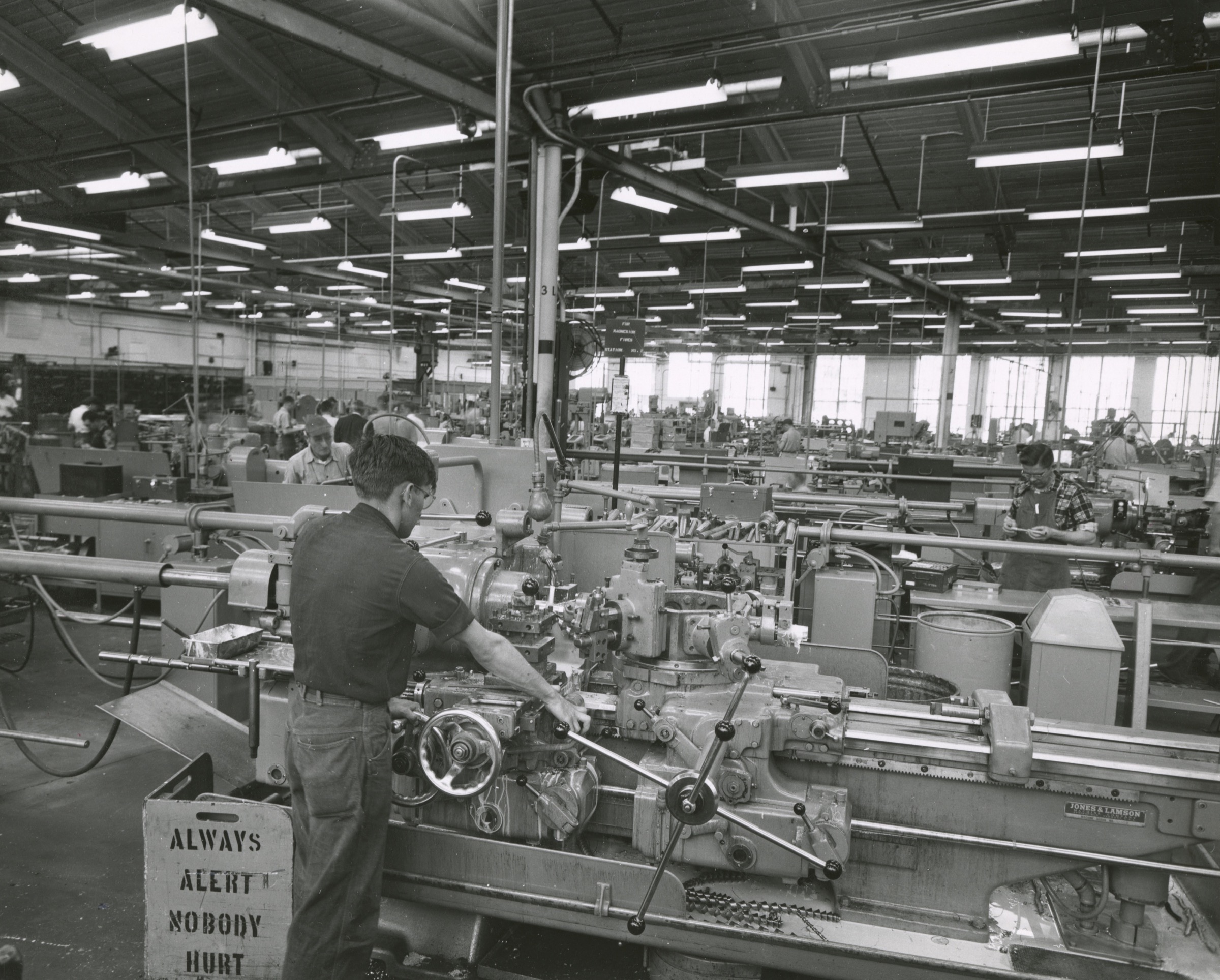
A fixed plant changes what another worker can add
In the short run, the plant and its machine capacity are fixed while labor can change. Early workers may divide tasks more effectively; after the easiest gains are used, limited machines and floor space can make each added worker increase output by less.