Now readingIntroduction
0%
AP Biology · Framework 2026-27
Unit 6

Gene Expression and Regulation

Information flows through directional nucleic-acid templates, regulated expression, and context-dependent molecular consequences.

Topics
8

Introduction

Information flows through directional nucleic-acid templates, regulated expression, and context-dependent molecular consequences.

DNA structure supports replication and transcription; RNA processing and translation connect selected sequence information to polypeptides.

Regulatory networks create cell identity, mutations alter information or expression, and biotechnology supplies bounded ways to measure or change DNA.

01
antiparallel complementarity

templated synthesis

02
transcription plus processing

mature RNA

03
translation

polypeptide sequence

04
regulation plus mutation

expression and variation

Current exam guidance: Aligned to the current 2026–27 AP Biology course framework, including scientific practices, data analysis, and model-based reasoning.
6.1

DNA and RNA Structure

How does nucleic-acid structure support information storage and templated copying?

Short answer

Directional sugar–phosphate backbones carry ordered bases, and antiparallel complementarity lets one strand specify another.
Know firstNucleotides · Covalent and hydrogen bonds · 5′ and 3′ notation

Direction belongs to the backbone; information belongs to sequence

Phosphodiester bonds join nucleotides into a strand with chemically distinct 5′ and 3′ ends. DNA strands align antiparallel, and A pairs with T while G pairs with C. Complementarity stabilizes the duplex and allows either strand to serve as a template. Hydrogen bonds join bases across strands; they are not the covalent backbone.

RNA usually contains ribose and uracil instead of deoxyribose and thymine. It is often single-stranded, but it can fold by complementary pairing within or between molecules. When reporting the partner in the same 5′-to-3′ reading direction, reverse the complement: the partner of 5′-AGTC-3′ is written 5′-GACT-3′.

Scientific source
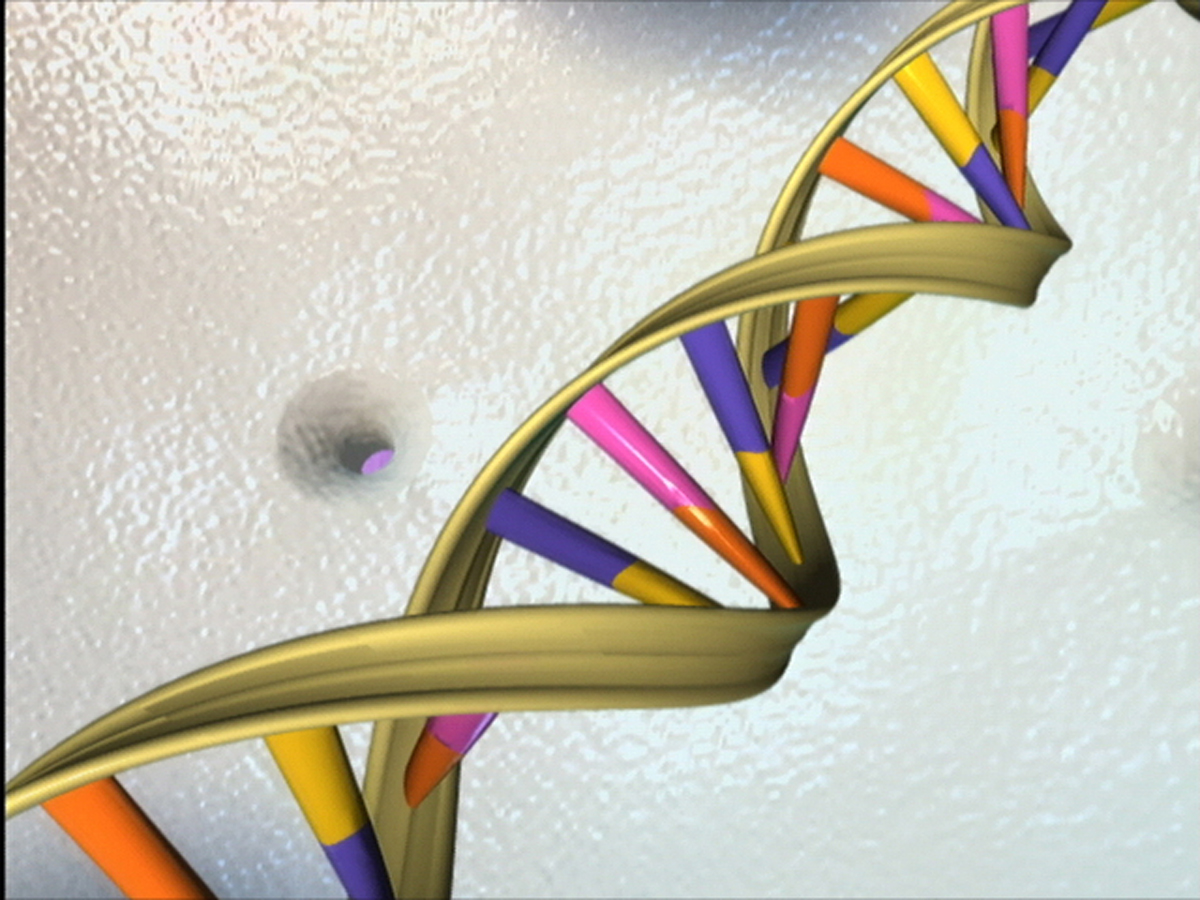
National Human Genome Research Institute model of a DNA double helix

The double helix makes paired information compact

Two strands coil around the same axis while paired bases occupy the interior. The model makes helicity visible, but it does not show the antiparallel 5′ and 3′ labels needed for synthesis problems.

Use this visual to see
Recognize paired strands and then add polarity from the lesson model.
What it cannot show
A three-dimensional molecular model shows two intertwined DNA backbones with bases between them. Colors distinguish molecular components but do not represent their appearance in a cell.

U.S. National Human Genome Research Institute · Public domain (NIH) · Wikimedia Commons item record

Orient a complementary duplex

Specific base pairing transfers sequence information while opposite backbone directions preserve antiparallel geometry.

Complementary strands run in opposite directionsCompute complements without losing polarity.
aligned
top
5′-AGTC-3′
bottom
3′-TCAG-5′
antiparallel
true
same reading direction
top
5′-AGTC-3′
reverseComplement
5′-GACT-3′

Non-color encodings: paired bases linked by rung marks; both ends carry direction labels

Entities

  • strand 5′-AGTC-3′
  • partner 3′-TCAG-5′
  • four base pairs

Rules

  • A pairs with T and G with C.
  • Paired strands are antiparallel.
  • Reverse-complement notation reads both sequences 5′ to 3′.
Orient a complementary duplex states
StateidtopbottomantiparallelreverseComplement
1aligned5′-AGTC-3′3′-TCAG-5′true—
2same-reading-direction5′-AGTC-3′——5′-GACT-3′

Separate structural roles

FeatureRole
sugar–phosphate backbonecovalent continuity and direction
base sequencestored information
complementary pairingtemplated copying and folding

Keep these three ideas

  • Backbones have 5′/3′ direction.
  • DNA strands pair antiparallel and complementary.
  • RNA differs chemically but can also base-pair.

Keep reading Unit 6: Gene Expression and Regulation

You just read the first topic free. Your free trial opens the rest of this unit, every AP Biology unit, and all 19 AP courses.

  • 6.1 DNA and RNA StructureRead
  • 6.2 DNA Replication
  • 6.3 Transcription and RNA Processing
  • 6.4 Translation
  • 6.5 Regulation of Gene Expression
  • 6.6 Gene Expression and Cell Specialization
  • 6.7 Mutations
  • 6.8 Biotechnology
Start my free 7 days →$0.00 due today · cancel anytime · score guarantee

Practice AP Biology in the real test engine.

Free practice set: timed, the same engine as our full-length tests, every answer explained.