Now readingIntroduction
0%
AP Macroeconomics · Framework 2026-27
Unit 2

Economic Indicators and the Business Cycle

GDP measures current domestic production, labor statistics classify employment status, price indices separate levels from rates of change, and business cycles describe fluctuations around longer-run capacity.

Exam weight
12–17%
Topics
7
long-run trendactual real output
Output moves around a long-run trendA rising straight trend line is paired with a wave-shaped actual-output line. The wave alternates above and below trend, representing expansions and contractions rather than a permanent clockwork cycle.

Introduction

GDP measures current domestic production, labor statistics classify employment status, price indices separate levels from rates of change, and business cycles describe fluctuations around longer-run capacity.

Accounting identities prevent double counting and keep flows in comparable units. Rate calculations require the correct denominator: the labor force for unemployment, the relevant population for participation, and the previous price index for inflation.

No single indicator is a complete measure of well-being. Real GDP removes price change from nominal output, while per-capita and distributional questions require additional information. Business-cycle evidence combines several indicators and remains separate from a policy recommendation.

01
GDP accounting

current domestic final production

02
Labor market

employment status, unemployment, and participation

03
Price measures

price level, inflation, and real values

04
Business cycle

actual output relative to longer-run capacity

Current exam guidance: Aligned to the current 2026–27 AP Macroeconomics framework. Models identify their axes, assumptions, time horizon, movement or shift, and quantitative consequence.
2.1

The Circular Flow and GDP

Why do expenditure, income, and value-added approaches measure the same production?

Short answer

The same final production creates an expenditure for a buyer, income for resource owners, and value added across producers, so correctly bounded totals agree.

Know firstMarket exchange · Stocks versus flows · Adding components without double counting

One production flow appears in three ledgers

Gross domestic product is the market value of final goods and services produced within a country during a period. The expenditure identity is Y=C+I+G+NXY=C+I+G+NX, where NX=X−MNX=X-M. Consumption covers household final purchases other than new housing. Investment includes business capital, new residential construction, and inventory change; it does not mean trading existing financial assets. Government purchases exclude transfers. Imports are subtracted because imported items may already appear in CC, II, or GG—not because an import is considered harmful.

Production also pays income and creates value added. A product whose three stages add 30, 25, and 45 currency units has final value 100; adding intermediate sales to the final sale would count the same production repeatedly. Inventory accumulation enters investment because the output was produced now even if it was not sold. Used goods, transfers, and purchases of financial assets are excluded from current production, while a current brokerage service on a used sale is included.

Economic model

Three views of 100 currency units of production

Connect the circular flow to equal expenditure, income, and value-added totals without double counting.

Held constant
Every item is current domestic production; intermediate values are not added to the final sale.
Time horizon
One accounting period.
Read the change
This is an accounting flow rather than a curve-shift model; changing one component changes measured GDP only if it changes current domestic final production.
Expenditure GDP
100
Income generated
100
Value added
100
Current domestic production
Three views of 100 currency units of productionExpenditure, income generated by production, and value added each total 100 currency units for the same period. The expenditure ledger is 62 plus 18 plus 24 plus 11 minus 15; the production stages add 30, 25, and 45.
Horizontal axis
Accounting approach
Vertical axis
Currency units per period
  • Expenditure: 62+18+24+11−15=100
  • Income: payments generated by the same current production
  • Value added: 30+25+45=100
Y=C+I+G+(X−M)Y=C+I+G+(X-M)

Expenditure, income generated by production, and value added each total 100 currency units for the same period. The expenditure ledger is 62 plus 18 plus 24 plus 11 minus 15; the production stages add 30, 25, and 45.

Read the model as a table
Three views of 100 currency units of production values
LedgerComponents or accounting boundaryTotal
Expenditure62+18+24+11−15100
Incomepayments generated by the same current production100
Value added30+25+45100
Economy in context
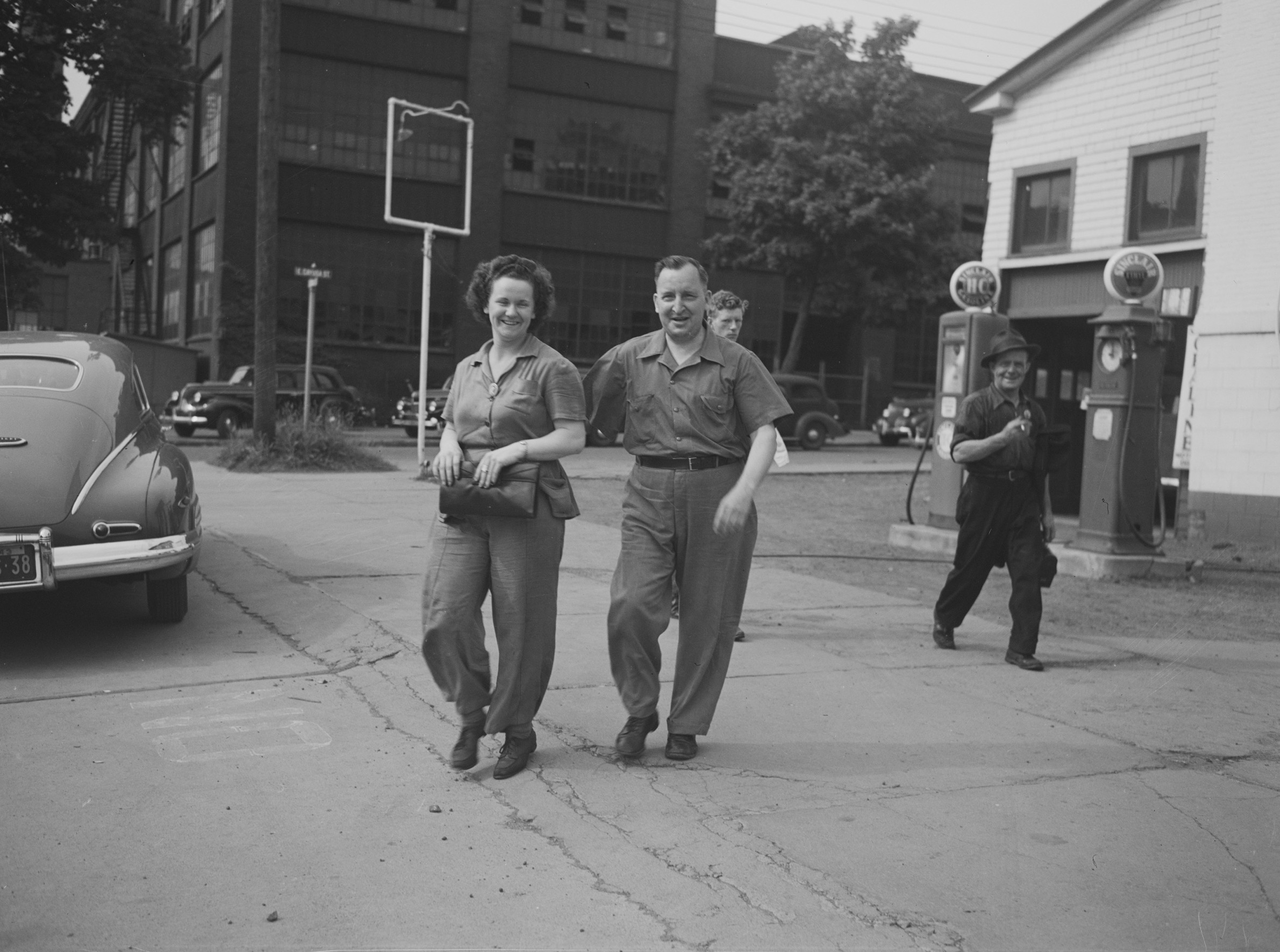
A woman and man in factory work clothes walking away from an industrial plant at the end of a shift in Oswego, New York, in June 1943.

Production creates both output and income

Workers provide labor to firms and receive income that can return to product markets as spending. National accounting records the resulting production, expenditure, and income as different views of the same activity.

Use this visual to see
Make the household–firm connection in the circular-flow model concrete before tracing the accounting identities.
What it cannot show
The image does not measure wages, value added, final expenditure, intermediate production, or total GDP.

Apply the production boundary

TransactionGDP treatmentReason
New domestic machineinvestmentcurrent final capital production
Unsold current outputinventory investmentproduced during the period
Government benefit paymentexcluded as a transfernot a purchase of current output
Used vehicle resalevehicle excluded; current dealer service includedonly the service is current production
Imported household goodappears in C and is subtracted in Mnot domestically produced

Keep these three ideas

  • GDP measures current domestic final production.
  • Expenditure, income, and value-added totals reconcile when boundaries match.
  • Transfers and asset trades are not current production.

Keep reading Unit 2: Economic Indicators and the Business Cycle

You just read the first topic free. Your free trial opens the rest of this unit, every AP Macroeconomics unit, and all 19 AP courses.

  • 2.1 The Circular Flow and GDPRead
  • 2.2 Limitations of GDP
  • 2.3 Unemployment
  • 2.4 Price Indices and Inflation
  • 2.5 Costs of Inflation
  • 2.6 Real v. Nominal GDP
  • 2.7 Business Cycles
Start my free 7 days →$0.00 due today · cancel anytime · score guarantee

Practice AP Macroeconomics in the real test engine.

Free practice set: timed, the same engine as our full-length tests, every answer explained.