Now readingIntroduction
0%
AP Physics 1: Algebra-Based · Framework 2026-27
Unit 7

Oscillations

Simple harmonic motion is periodic motion produced by a restoring interaction proportional and opposite to displacement from equilibrium.

Exam weight
5–8%
Topics
4

Introduction

Simple harmonic motion is periodic motion produced by a restoring interaction proportional and opposite to displacement from equilibrium.

This unit connects one physical condition—restoring force proportional to displacement—to period, phase, graphs, and energy. Always define displacement from equilibrium before using an SHM relation. A motion can repeat without being simple harmonic.

The spring equations assume an ideal spring and negligible damping. The pendulum period additionally assumes a small angle. These models predict what changes the period and how displacement, velocity, acceleration, kinetic energy, and potential energy trade places during a cycle.

01
Restoring interaction

SHM condition

02
System parameters

period and frequency

03
Phase landmarks

motion representations

04
Amplitude and position

energy distribution

Current exam guidance: Aligned to the current 2026–27 AP Physics 1 framework, with algebra-based modeling, experimental reasoning, and explicit assumptions.
7.1

Defining Simple Harmonic Motion (SHM)

What distinguishes simple harmonic motion from motion that merely repeats?

Short answer

In SHM, the net restoring force—and therefore acceleration—is proportional to displacement from equilibrium and points back toward equilibrium.

Know firstNewton’s second law · Spring force · Equilibrium position

The force law defines the motion

Choose the oscillating object as the system, place the origin at its equilibrium position, and call rightward displacement positive. For an ideal horizontal mass–spring system with negligible friction, the spring’s net force is Fx=−kxF_x=-kx. Newton’s second law then gives ax=−(k/m)xa_x=-(k/m)x. The minus sign is directional: a positive displacement produces negative acceleration, and a negative displacement produces positive acceleration.

That proportional, opposite relationship is the defining feature of SHM. At equilibrium, x=0x=0, so the net force and acceleration are zero; the object can nevertheless be moving fastest there. At either turning point, the velocity is momentarily zero while the restoring force and acceleration have their greatest magnitudes. A motion that repeats but has a nonlinear force–position relation is periodic without being simple harmonic.

A pendulum approaches SHM only at small angles, where its restoring effect is nearly proportional to angular displacement. At larger angles, the exact sine dependence matters and the ideal SHM timing no longer applies. “Toward equilibrium” also need not mean “toward the coordinate origin” unless the origin was deliberately placed at equilibrium.

Physics model

Simple harmonic motion needs a linear restoring force

Move an oscillator through equilibrium and compare displacement with the oppositely directed restoring acceleration.

Displacement
0.6 m
Restoring acceleration
-2.4 m/s²
equilibriumdisplacementrestoring acceleration
Simple harmonic motion needs a linear restoring forceMove an oscillator through equilibrium and compare displacement with the oppositely directed restoring acceleration. The table below states the model assumptions and relationships without relying on color or motion.equilibrium
a=−ω2xa=-\omega^2x
Read this figure without the graphic

Move an oscillator through equilibrium and compare displacement with the oppositely directed restoring acceleration. The table below states the model assumptions and relationships without relying on color or motion.

QuantityMeaning
At equilibriumRestoring force is zero and speed may be greatest
At endpointsSpeed is zero and restoring magnitude greatest
SHM conditionAcceleration proportional to −x-x
Physics in practice
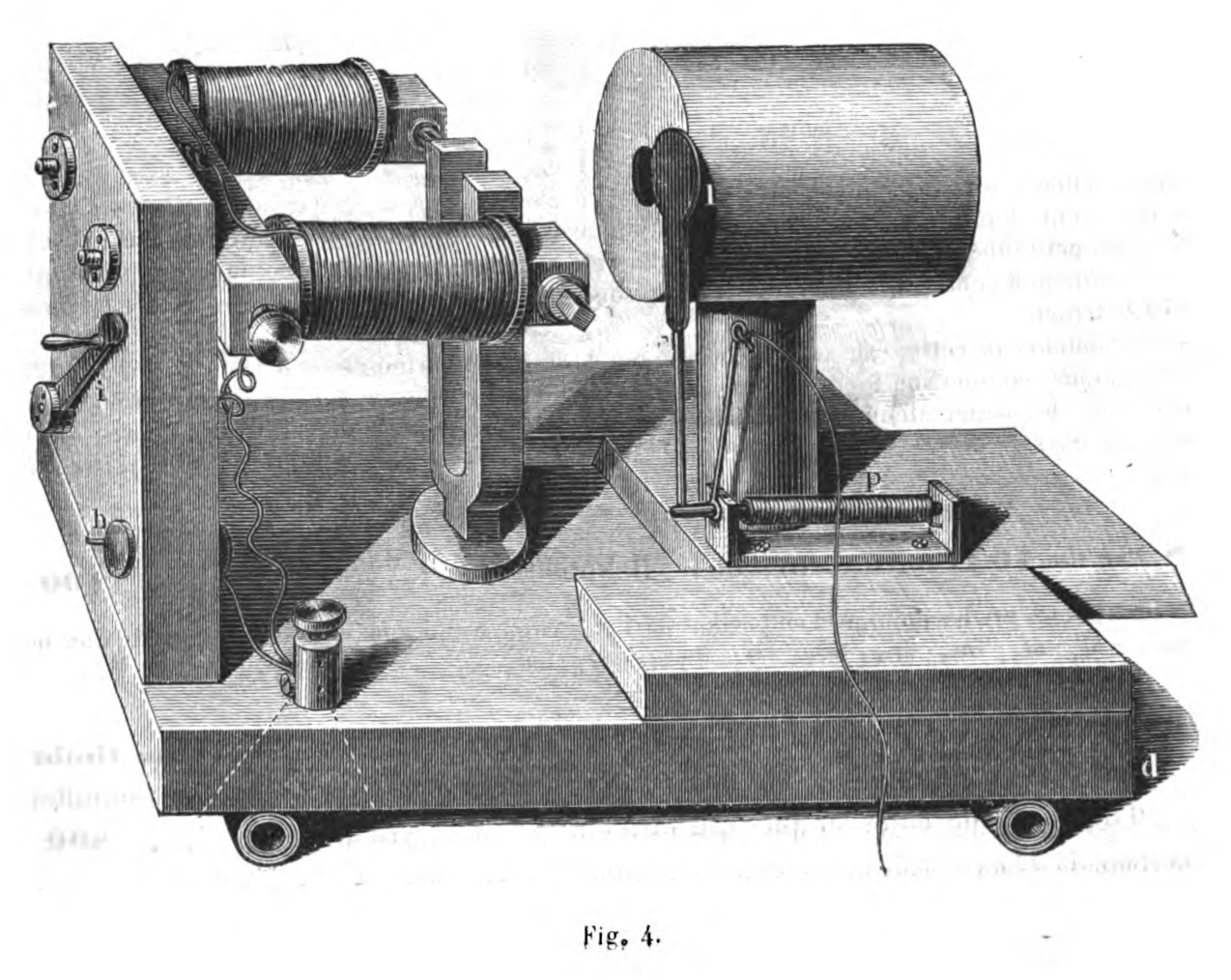
Historical Koenig tuning fork and resonator mounted on a laboratory base.

A tuning fork supplies a repeatable restoring system

When displaced, the fork’s elastic tines accelerate back toward equilibrium. For small motion, the restoring response is approximately linear and the resulting oscillation is close to simple harmonic.

Use this visual to see
Identify equilibrium, displacement, and restoring behavior in a physical oscillator.
What it cannot show
The engraving does not show the tine motion over time, damping, frequency, amplitude, or deviations from the linear model.

Connect force to acceleration

  1. Fx=−kxF_x=-kx gives the signed spring force.
  2. Apply Fx=maxF_x=ma_x to the cart.
  3. Divide by mm without changing the sign.
Result
ax=−kmxa_x=-\frac{k}{m}x
Units: kk in N/m, mm in kg, xx in m, and axa_x in m/s2^2

Boundary cases

  • x=0x=0 gives Fx=ax=0F_x=a_x=0.
  • This relation does not describe a stretched spring outside its linear range.

Acceleration is a straight-line function of displacement with negative slope k divided by m.

Decide whether a motion is SHM

  1. Define displacement from equilibrium.
  2. Write or infer the net force as a function of displacement.
  3. Check that the relation is linear through the origin with a negative slope.
  4. State the interval over which the physical system obeys that approximation.

Keep these three ideas

  • SHM requires a restoring effect proportional and opposite to displacement.
  • Force and acceleration vanish at equilibrium, not necessarily velocity.
  • Every model claim must name its linear or small-angle range.

Keep reading Unit 7: Oscillations

You just read the first topic free. Your free trial opens the rest of this unit, every AP Physics 1 unit, and all 19 AP courses.

  • 7.1 Defining Simple Harmonic Motion (SHM)Read
  • 7.2 Frequency and Period of SHM
  • 7.3 Representing and Analyzing SHM
  • 7.4 Energy of Simple Harmonic Oscillators
Start my free 7 days →$0.00 due today · cancel anytime · score guarantee

Practice AP Physics 1 in the real test engine.

Free practice set: timed, the same engine as our full-length tests, every answer explained.