Now readingIntroduction
0%
AP Physics C: Electricity and Magnetism · Framework 2026-27
Unit 2

Electric Potential

Electric potential turns a conservative vector interaction into a scalar energy map: charge configurations have potential energy, potential is energy per charge, and potential differences predict energy transfer.

Exam weight
10–20%
Topics
3

Introduction

Electric potential turns a conservative vector interaction into a scalar energy map: charge configurations have potential energy, potential is energy per charge, and potential differences predict energy transfer.

Begin by declaring the charge system and the zero of potential energy. Pair energy belongs to the configuration, not to either charge alone. Electric potential removes the test-charge factor, so source contributions add as scalars even though the field recovered from the potential is a vector.

A potential difference connects work, field, and motion through ΔU=qΔV\Delta U=q\Delta V and ΔV=−∫E⃗⋅dl⃗\Delta V=-\int\vec E\cdot d\vec l. Conservation predicts a particle’s speed when all transfers are included, but charge sign and the local field are still needed to determine force direction.

01
Configuration energy

sum each unique charge pair once

02
Potential

add scalar source contributions and choose a reference

03
Field from potential

use the negative spatial gradient

04
Energy conservation

translate qΔVq\Delta V into kinetic or external-work changes

Current exam guidance: Aligned to the current 2026–27 AP Physics C: Electricity and Magnetism framework, with calculus-based field, circuit, and induction models, explicit assumptions, and experimental reasoning.
9.1

Electric Potential Energy

How does a collection of charges store electrostatic interaction energy?

Short answer

Relative to a stated zero, add keqiqj/rijk_eq_iq_j/r_{ij} once for every distinct pair; the sign records whether assembly required positive or negative external work.

Know firstConservative work · Coulomb force · System energy

Energy belongs to the configuration

For two point charges with zero energy chosen at infinite separation, U=keq1q2/rU=k_eq_1q_2/r. Like-sign pairs have positive UU because an external agent must do positive work to assemble them quasistatically from infinity. Unlike-sign pairs have negative UU because the electric force releases energy during assembly. A negative value is permitted; it marks a configuration below the chosen zero.

For many point charges, U=∑i<jkeqiqj/rijU=\sum_{i<j}k_eq_iq_j/r_{ij}. The restriction i<ji<j counts each pair once. Do not add a charge’s interaction with itself; ideal point-charge self-energy is singular and continuous-distribution assembly needs a different integral treatment. Energy differences obey ΔU=−WE\Delta U=-W_E, where WEW_E is work done by the electric force.

Physics model

Electric potential energy belongs to the charge system

Change the separation of +2 μC and −3 μC point charges. With zero energy at infinity, their interaction energy is negative and falls as the charges move closer.

Separation
2 m
Potential energy
-0.027 J
Force direction
toward smaller separation
positive chargenegative chargepotential-energy curvecurrent state
Electric potential energy belongs to the charge systemUnlike point charges accompany a negative potential-energy curve. A moving state marker links their current separation to the energy measured from zero at infinity.U(r) = −0.053928/r Jr (m)U (J)+−attractive pairzero at infinity
UE=kq1q2rU_E=k\frac{q_1q_2}{r}
Read this figure without the graphic

Unlike point charges accompany a negative potential-energy curve. A moving state marker links their current separation to the energy measured from zero at infinity.

Current quantityValue
Separation2 m
Potential energy-0.027 J
Force directiontoward smaller separation
Model relationUE=kq1q2rU_E=k\frac{q_1q_2}{r}
Physics in practice
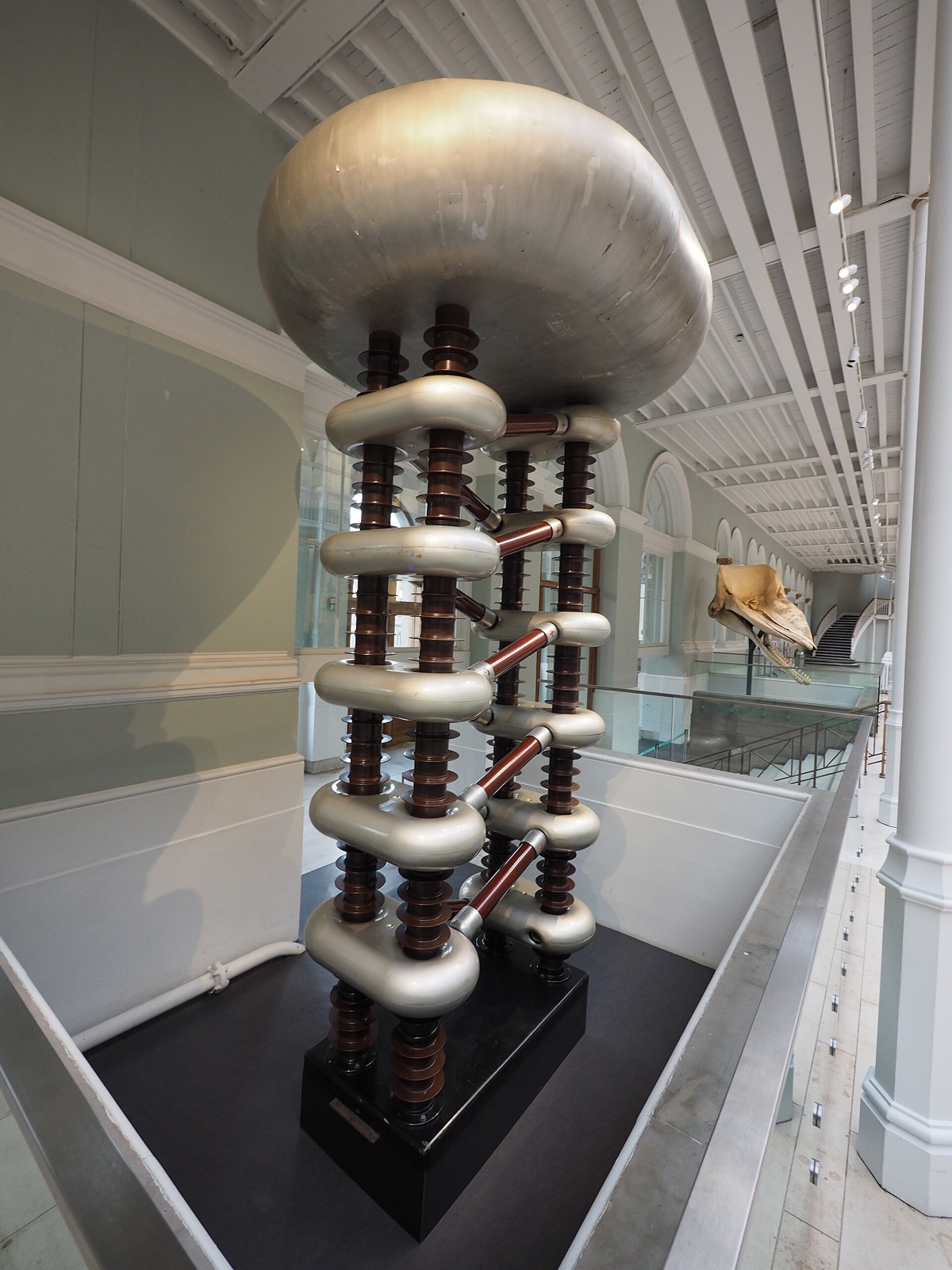
Tall Cockcroft–Walton voltage multiplier with repeated capacitor and rectifier stages inside a laboratory.

A voltage multiplier builds a large potential-energy change in stages

Each repeated stage contributes to a much larger total potential difference. A charge moving through that total difference changes electric potential energy by its charge multiplied by the change in potential.

Use this visual to see
Relate electric potential energy to the accumulated potential difference across a multistage device.
What it cannot show
The photograph shows a vertical sequence of electrical stages, but it does not identify the voltage of a stage, total voltage, charge motion, polarity, stored energy, or conversion losses.

Build a three-charge pair ledger

  1. List the three unique edges: (q,−2q)(q,-2q), (q,3q)(q,3q), and (−2q,3q)(-2q,3q).
  2. Their dimensionless charge products are −2q2-2q^2, +3q2+3q^2, and −6q2-6q^2.
  3. Because every separation is aa, factor out ke/ak_e/a.
  4. Add the three pair coefficients: −2+3−6=−5-2+3-6=-5.
Result
U=−5keq2aU=-\frac{5k_eq^2}{a}
Units: keq2/ak_eq^2/a has units joules.

Boundary cases

  • U→0U\to0 as every pair separation tends to infinity.
  • Permuting charge labels cannot change the total pair energy.

The triangle has three edges, and adding their signed pair energies once gives a total coefficient of negative five.

Count each pair exactly once

Pairqiqj/q2q_iq_j/q^2Contribution
qq with −2q-2q−2-2−2keq2/a-2k_eq^2/a
qq with 3q3q+3+3+3keq2/a+3k_eq^2/a
−2q-2q with 3q3q−6-6−6keq2/a-6k_eq^2/a
total−5-5−5keq2/a-5k_eq^2/a

Evaluate a charge configuration

  1. Declare which charges belong to the system.
  2. State the zero of potential energy.
  3. List every unordered pair once.
  4. Use the actual pair separation and signed charge product.
  5. Add scalar contributions and test large-separation or permutation limits.

Keep these three ideas

  • Potential energy is a property of a chosen charge configuration.
  • Every unique pair contributes once.
  • Negative energy is meaningful relative to the chosen zero.

Keep reading Unit 2: Electric Potential

You just read the first topic free. Your free trial opens the rest of this unit, every AP Physics C: E&M unit, and all 19 AP courses.

  • 9.1 Electric Potential EnergyRead
  • 9.2 Electric Potential
  • 9.3 Conservation of Electric Energy
Start my free 7 days →$0.00 due today · cancel anytime · score guarantee

Practice AP Physics C: E&M in the real test engine.

Free practice set: timed, the same engine as our full-length tests, every answer explained.