Now readingIntroduction
0%
AP Physics C: Electricity and Magnetism · Framework 2026-27
Unit 4

Electric Circuits

Circuit analysis combines charge conservation at junctions with energy conservation around loops, then adds constitutive laws for each component.

Exam weight
15–25%
Topics
8

Introduction

Circuit analysis combines charge conservation at junctions with energy conservation around loops, then adds constitutive laws for each component.

Current measures charge transport, while voltage tracks energy transferred per charge. A schematic records electrical connections rather than physical distances, so the first task is always to identify nodes, branches, and closed paths.

Resistance, capacitance, sources, and meters provide component rules. Kirchhoff’s laws connect those local rules into a system; in an RC circuit the same laws become a differential equation that predicts the transient state.

01
Charge crossing a surface

current and current density

02
Material plus geometry

resistance

03
Node charge conservation

junction rule

04
Loop energy conservation

loop rule

05
Capacitance plus resistance

exponential transient

Current exam guidance: Aligned to the current 2026–27 AP Physics C: Electricity and Magnetism framework, with calculus-based field, circuit, and induction models, explicit assumptions, and experimental reasoning.
11.1

Electric Current

How do macroscopic current and microscopic carrier motion describe the same charge transport?

Short answer

Current is the signed rate I=dQ/dtI=dQ/dt through a chosen cross section; microscopically it is the flux of current density, I=∫AJ⃗⋅dA⃗I=\int_A\vec J\cdot d\vec A.

Know firstCharge conservation · Definite integrals · Vector flux

Current counts net crossing, not particle speed

Choose an orientation for a wire and an area normal. Positive current means net positive charge crosses in that direction. Conventional current therefore points opposite the drift of electrons in a metal. Although J⃗\vec J is a vector, the current through an oriented surface is a signed scalar.

For uniform carriers, J⃗=nqv⃗d\vec J=nq\vec v_d and I=nqAvdI=nqAv_d after consistent sign choices. The tiny drift velocity sits on top of much faster random microscopic motion. In steady series flow, current is not consumed by a resistor; different carrier density or cross-sectional area instead changes drift speed.

Physics model

Current is charge flow through an oriented area

Increase electron drift-speed magnitude in a wire with n = 8.0×10²⁸ m⁻³ and A = 1.00 mm². Conventional current points opposite electron drift and grows in proportion to its magnitude.

Drift speed
1.5 mm/s
Current magnitude
19.224 A
Electron motion
opposite conventional current
conducting wiremobile electronsconventional currentcross section
Current is charge flow through an oriented areaMobile electrons occupy a cylindrical wire and drift opposite a conventional-current arrow. A highlighted cross section marks the area used in the current integral.++++++++++++++++−−−−−−−−−−−−−−−−conventional currentelectron driftA = 1.00 mm²
J⃗=nqv⃗dI=n∣q∣Avd(magnitude)\begin{gathered}\vec J=nq\vec v_d\\I=n|q|Av_d\quad\text{(magnitude)}\end{gathered}
Read this figure without the graphic

Mobile electrons occupy a cylindrical wire and drift opposite a conventional-current arrow. A highlighted cross section marks the area used in the current integral.

Current quantityValue
Drift speed1.5 mm/s
Current magnitude19.224 A
Electron motionopposite conventional current
Model relationJ⃗=nqv⃗dI=n∣q∣Avd(magnitude)\begin{gathered}\vec J=nq\vec v_d\\I=n|q|Av_d\quad\text{(magnitude)}\end{gathered}
Physics in practice
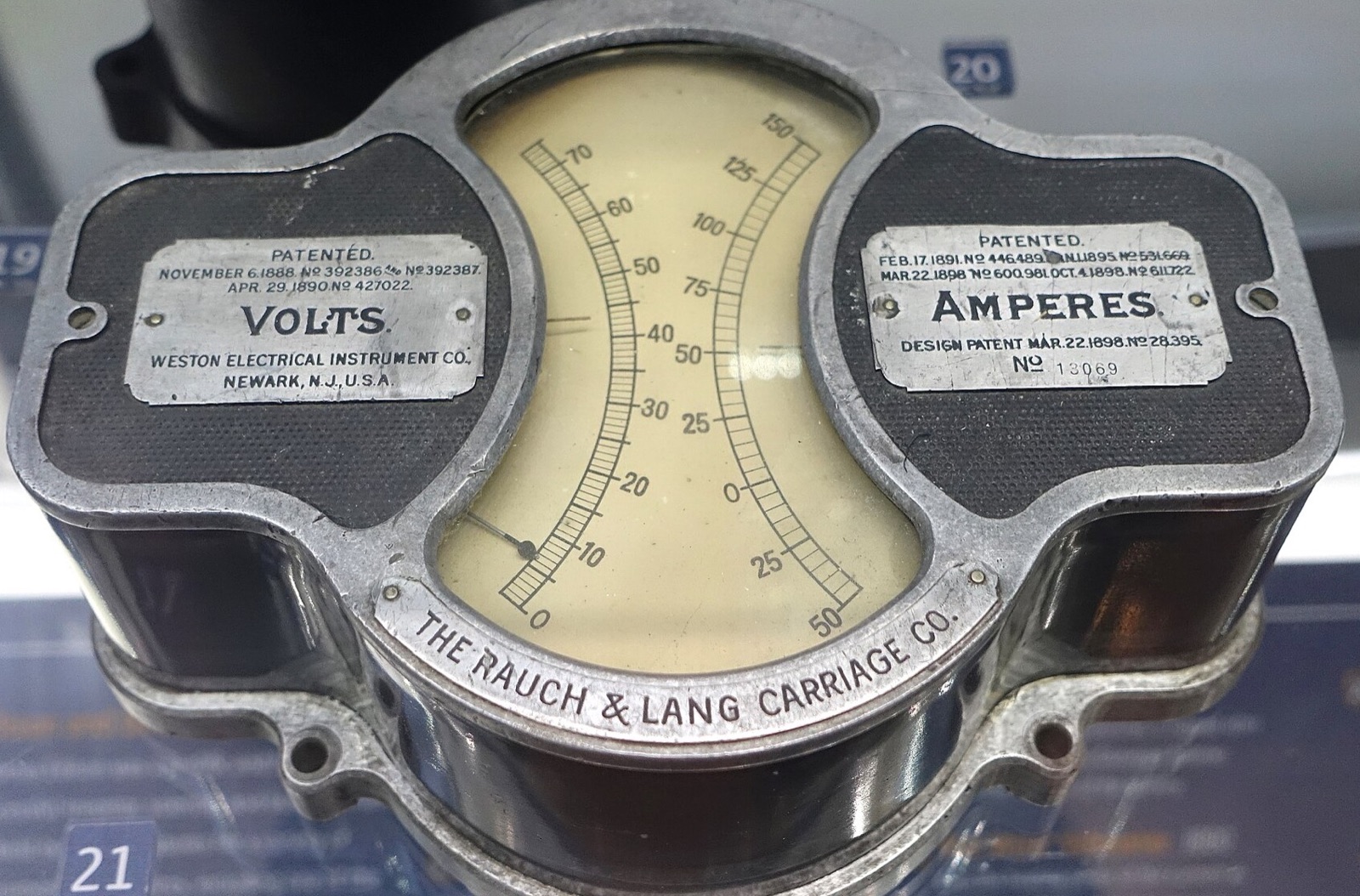
Historic Weston electrical instrument with separate volts and amperes scales around one pointer.

Current becomes a reading only after the meter joins the circuit

The two scales show that current and potential difference are different measurements even when one instrument can report either quantity. To measure current, the instrument must be connected in series so the branch charge flow passes through it.

Use this visual to see
Connect electric current to a physical meter reading while distinguishing current measurement from voltage measurement.
What it cannot show
The close view shows one pointer between a volts scale and an amperes scale. It does not show the instrument connected to a circuit, identify the selected mode, or establish current direction, drift speed, or internal resistance.

Recover transported charge from a current history

  1. Integrate current over the exact time interval.
  2. Keep the sign of current in the integral.
  3. Interpret the result relative to the selected surface normal.
Result
ΔQ=∫03(0.4+0.2t) dt=2.1 C\Delta Q=\int_0^3(0.4+0.2t)\,dt=2.1\ \mathrm C
Units: 1 A=1 C/s1\ \mathrm A=1\ \mathrm{C/s}.

Boundary cases

  • A reversing current can give zero net transported charge despite nonzero total traffic.
  • Zero current means zero net drift, not zero microscopic motion.

The area under the current-versus-time graph is two point one coulombs.

Separate transport quantities

QuantityDefinitionCharacter
current IIdQ/dtdQ/dtsigned scalar for a path
current density J⃗\vec Jnqv⃗dnq\vec v_dvector field
transported charge∫I dt\int I\,dtsigned accumulation

Set a current convention

  1. Choose the path direction or surface normal.
  2. Identify carrier charge sign and drift direction.
  3. Use flux for a nonuniform current density.
  4. Integrate in time for transported charge.
  5. Check C/s for current and A/m² for current density.

Keep these three ideas

  • Current is signed charge rate.
  • Current density carries spatial direction.
  • Conventional current opposes electron drift in metals.

Keep reading Unit 4: Electric Circuits

You just read the first topic free. Your free trial opens the rest of this unit, every AP Physics C: E&M unit, and all 19 AP courses.

  • 11.1 Electric CurrentRead
  • 11.2 Simple Circuits
  • 11.3 Resistance, Resistivity, and Ohm’s Law
  • 11.4 Electric Power
  • 11.5 Compound Direct Current Circuits
  • 11.6 Kirchhoff’s Loop Rule
  • 11.7 Kirchhoff’s Junction Rule
  • 11.8 Resistor-Capacitor (RC) Circuits
Start my free 7 days →$0.00 due today · cancel anytime · score guarantee

Practice AP Physics C: E&M in the real test engine.

Free practice set: timed, the same engine as our full-length tests, every answer explained.