Now readingIntroduction
0%
AP Physics C: Electricity and Magnetism · Framework 2026-27
Unit 5

Magnetic Fields and Electromagnetism

Magnetic fields are vector fields produced by moving charge and current; cross products determine their directions, while Biot–Savart and Ampère’s law determine magnitudes under stated geometric conditions.

Exam weight
10–20%
Topics
4

Introduction

Magnetic fields are vector fields produced by moving charge and current; cross products determine their directions, while Biot–Savart and Ampère’s law determine magnitudes under stated geometric conditions.

Magnetic reasoning begins with three declarations: the current or moving charge that creates the field, the point where the field is evaluated, and the positive directions used for cross products. Field lines are a representation of the vector field, not paths that charges must follow.

Biot–Savart works for the permitted source geometries without requiring global symmetry. Ampère’s law is always a circulation statement for steady current, but it becomes a shortcut for field magnitude only when symmetry makes the line integral simple. Magnetic force, energy, and material response remain separate parts of the model.

01
Magnetic sources and materials

field representation and superposition

02
Moving charge in a field

Lorentz force and curved trajectories

03
Current elements

Biot–Savart fields and wire forces

04
Steady-current symmetry

Ampèrian circulation

Current exam guidance: Aligned to the current 2026–27 AP Physics C: Electricity and Magnetism framework, with calculus-based field, circuit, and induction models, explicit assumptions, and experimental reasoning.
12.1

Magnetic Fields

How should a magnetic field and a material’s response to it be represented?

Short answer

The magnetic field B⃗\vec B is a superposing vector measured in tesla; its field lines form closed loops, while a material’s response depends on dipole alignment and permeability.

Know firstVector components · Field representations · Three-dimensional direction notation

A field map records a vector at every point

A magnetic-field arrow gives the direction a compass north-seeking end would point and a scale gives magnitude. Into-page and out-of-page symbols are shorthand for a third component, so pair them with words or a coordinate label. Field lines are tangent to B⃗\vec B, never cross, and form closed loops. They do not begin at a north pole or end at a south pole; cutting a bar magnet produces smaller dipoles rather than isolated magnetic poles.

Fields superpose component by component. The apparent density of drawn lines can suggest relative magnitude, but it is not a count of magnetic substance. Gauss’s law for magnetism, ∮B⃗⋅dA⃗=0\oint\vec B\cdot d\vec A=0, states that the signed magnetic flux through every closed surface is zero. It does not say the field on that surface is zero.

Matter changes the relationship between sources and field. Ferromagnetic domains can align strongly and retain magnetization. Paramagnetic dipoles align weakly with an applied field, while an induced diamagnetic response opposes the applied field. Permeability summarizes a material response only within its stated regime; temperature, direction, and field strength can matter, so it is not universally constant.

Physics model

Magnetic field is a vector at every point

Change a transverse field component while the horizontal component stays fixed. A compass aligns with the vector sum, not with either component separately.

Components
⟨50,40⟩\langle50,40\rangle μT
Magnitude
64.031 μT
Direction
38.7°
horizontal componenttransverse componentnet magnetic fieldcompass direction
Magnetic field is a vector at every pointHorizontal and transverse magnetic-field component arrows begin at a common point. Their diagonal resultant gives the compass direction.vector componentscompass
B⃗=∑iB⃗i\vec B=\sum_i\vec B_i
Read this figure without the graphic

Horizontal and transverse magnetic-field component arrows begin at a common point. Their diagonal resultant gives the compass direction.

Current quantityValue
Components⟨50,40⟩\langle50,40\rangle μT
Magnitude64.031 μT
Direction38.7°
Model relationB⃗=∑iB⃗i\vec B=\sum_i\vec B_i
Physics in practice
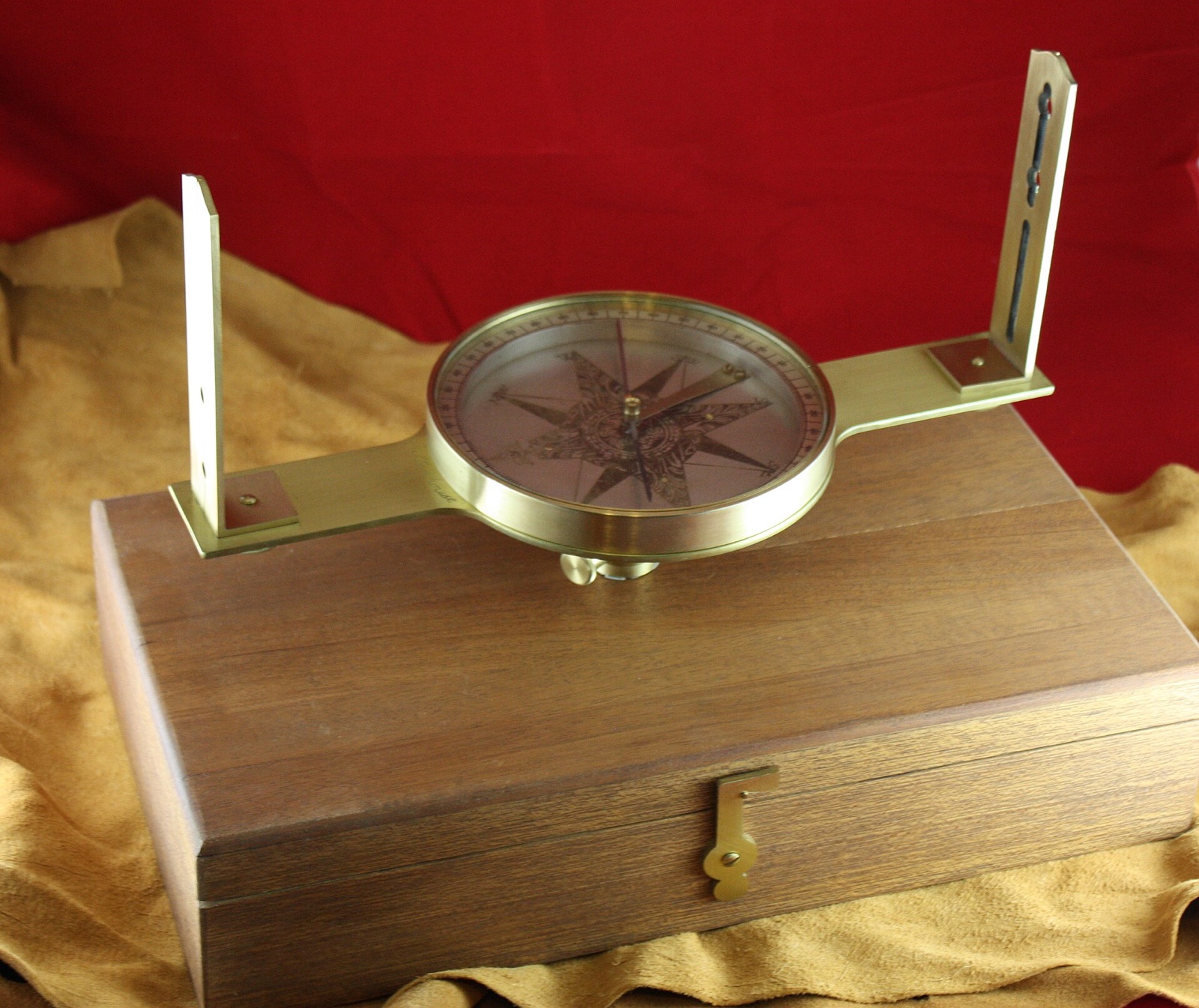
Historic circumferentor with a magnetic compass, sighting vanes, leveling hardware, and circular scale.

A compass samples the direction of the local magnetic field

A freely rotating magnet aligns with the local magnetic field, turning field direction into an observable orientation. Repeating the measurement at many positions is necessary to map a field.

Use this visual to see
Give operational meaning to magnetic-field direction without treating a field line as a physical object.
What it cannot show
The photograph shows the compass needle, circular scale, sights, and supports but does not isolate Earth’s field from nearby sources or provide field magnitude, vector components, or a field map.
Formula

Superpose components and preserve closed flux

B⃗net=∑iB⃗i,∮SB⃗⋅dA⃗=0\vec B_{net}=\sum_i\vec B_i,\qquad \oint_S\vec B\cdot d\vec A=0

Independent magnetic contributions add as vectors, and every closed surface has zero net magnetic flux.

Use when
All contributions use one coordinate basis; the flux statement applies to a closed oriented surface.
Do not assume
Zero closed-surface flux does not imply zero local field, and field-line counts are not numerical flux data.
Variables
B⃗\vec B: magnetic field (T) · dA⃗d\vec A: outward-oriented area element (m2^2)
Common misuse
Adding field magnitudes while ignoring opposing components.

Separate the material responses

Material modelTypical response to an applied fieldAfter the field is removed
diamagneticweak induced response opposing the applied fieldresponse largely vanishes
paramagneticweak alignment with the applied fieldalignment largely vanishes
ferromagneticstrong domain alignmentsubstantial alignment may remain

Read or build a magnetic-field map

  1. Declare the coordinate axes and translate page symbols into signed components.
  2. Identify each source and determine its field direction independently.
  3. Add components before calculating the resultant magnitude.
  4. Check that field lines close and never cross.
  5. State whether a permeability or dipole model is valid for the material and conditions.

Keep these three ideas

  • Magnetic fields are vectors and superpose by component.
  • Magnetic field lines form closed loops.
  • Material response depends on dipole behavior and the applicable permeability model.

Keep reading Unit 5: Magnetic Fields and Electromagnetism

You just read the first topic free. Your free trial opens the rest of this unit, every AP Physics C: E&M unit, and all 19 AP courses.

  • 12.1 Magnetic FieldsRead
  • 12.2 Magnetism and Moving Charges
  • 12.3 Magnetic Fields of Current-Carrying Wires and the Biot-Savart Law
  • 12.4 Ampère’s Law
Start my free 7 days →$0.00 due today · cancel anytime · score guarantee

Practice AP Physics C: E&M in the real test engine.

Free practice set: timed, the same engine as our full-length tests, every answer explained.