Torque and Rotational Dynamics
Rotational motion becomes predictive when angular change, force geometry, and mass distribution are all measured about the same axis.
- Exam weight
- 10–15%
- Topics
- 6
Introduction
Rotational motion becomes predictive when angular change, force geometry, and mass distribution are all measured about the same axis.
Angular position generates angular velocity and acceleration through derivatives. Radius converts those shared angular quantities into different linear motion for different points of a rigid body.
Torque is the moment of force about a chosen axis, while rotational inertia is the second moment of mass about that axis. For a rigid body with fixed inertia, their signed relation determines angular acceleration.
angular velocity and acceleration
linear motion of a rigid-body point
torque
rotational inertia
static equilibrium
angular acceleration
Rotational Kinematics
How do derivatives and integrals connect angular position, velocity, and acceleration?
For rotation about a fixed axis, and ; integrating reverses those relationships.
Angular derivatives describe rigid-body rotation
Advance time and compare angle, angular velocity, and angular acceleration for one rotating radius.
- Angle
- 2 rad
- Angular velocity
- 2 rad/s
- Angular acceleration
- 1 rad/s²
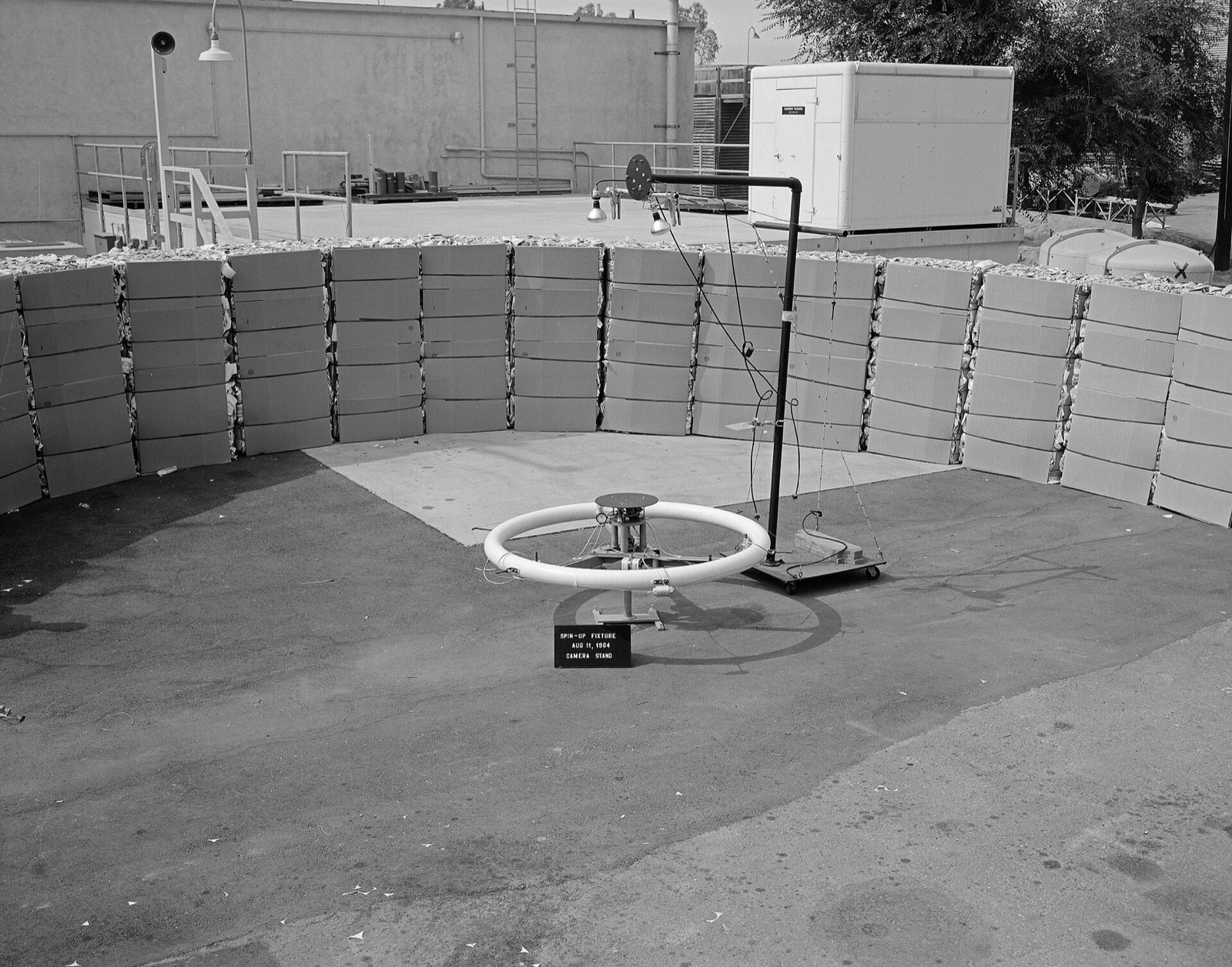
A spin test checks rotational behavior before flight
A rigid spacecraft rotates about a test axis while engineers monitor balance and response. Angular position, angular velocity, and angular acceleration describe different parts of that motion.