Now readingIntroduction
0%
AP Physics C: Mechanics · Framework 2026-27
Unit 6

Energy and Momentum of Rotating Systems

Calculus connects torque to rotational work and angular impulse, while conservation laws explain rolling, changing mass distributions, and orbital motion.

Exam weight
10–15%
Topics
6

Introduction

Calculus connects torque to rotational work and angular impulse, while conservation laws explain rolling, changing mass distributions, and orbital motion.

Rotation uses familiar mechanics principles with one added discipline: every torque, inertia, and angular momentum must be defined about an axis or origin. Integrating torque over angle transfers energy; integrating torque over time changes angular momentum. Those two areas answer different physical questions.

Rolling motion combines translation and rotation through a no-slip constraint. Orbital motion combines inverse-square gravity with energy and angular momentum. In both settings, the constraint determines which compact relationships are valid and when the full vector or integral law is needed.

01
Mass distribution and angular speed

rotational kinetic energy

02
Torque integrated over angle

rotational work

03
Torque integrated over time

angular impulse

04
Negligible external angular impulse

angular-momentum conservation

05
No-slip or central-force constraint

rolling and orbital relations

Current exam guidance: Aligned to the current 2026–27 AP Physics C: Mechanics framework, with calculus-based modeling, derivations, experimental reasoning, and explicit assumptions.
6.1

Rotational Kinetic Energy

Why does rotational kinetic energy depend on the squared distance of each mass element from the axis?

Short answer

Because a rigid body’s mass element moves at v=rωv=r\omega, integrating 12v2 dm\tfrac12v^2\,dm gives Krot=12Iω2K_{rot}=\tfrac12I\omega^2 with I=∫r2 dmI=\int r^2\,dm.

Know firstRigid-body kinematics · Rotational inertia integrals · Center-of-mass motion

Energy is distributed throughout the body

Choose an axis and divide a rigid body into infinitesimal mass elements. An element a perpendicular distance rr from the axis has speed v=rωv=r\omega. Its kinetic energy is dK=12(rω)2 dmdK=\tfrac12(r\omega)^2\,dm. Since every element shares the same angular speed, integration gives Krot=12ω2∫r2 dm=12Iω2K_{rot}=\tfrac12\omega^2\int r^2\,dm=\tfrac12I\omega^2. The r2r^2 weighting means a small amount of distant mass can contribute strongly to both inertia and energy.

For general planar motion, separate translation of the center of mass from rotation about it: K=12Mvcm2+12Icmω2K=\tfrac12Mv_{cm}^2+\tfrac12I_{cm}\omega^2. This decomposition avoids double counting. Using an inertia about an instantaneous contact point and then adding center-of-mass translation would count the same motion twice.

The comparison depends on what remains fixed. At fixed ω\omega, larger II means larger energy. At fixed angular momentum, K=L2/(2I)K=L^2/(2I), so larger II means smaller energy. Rotational kinetic energy is a nonnegative scalar: reversing the sign of ω\omega changes the rotation direction but not KrotK_{rot}. State the constraint before drawing a proportionality conclusion.

Physics model

Rotation stores kinetic energy across the whole mass distribution

Change signed angular velocity and see that reversing rotation leaves the quadratic rotational energy unchanged.

Rotational inertia
2 kg·m²
Angular velocity
5 rad/s
Direction
counterclockwise
Rotational energy
25 J
rigid bodysigned angular velocityrotational energy
Rotation stores kinetic energy across the whole mass distributionChange signed angular velocity and see that reversing rotation leaves the quadratic rotational energy unchanged.Krot
Krot=12Iω2K_{rot}=\tfrac12I\omega^2
Read this figure without the graphic

Change signed angular velocity and see that reversing rotation leaves the quadratic rotational energy unchanged.

Current quantityValue
Rotational inertia2 kg·m²
Angular velocity5 rad/s
Directioncounterclockwise
Rotational energy25 J
Model relationKrot=12Iω2K_{rot}=\tfrac12I\omega^2
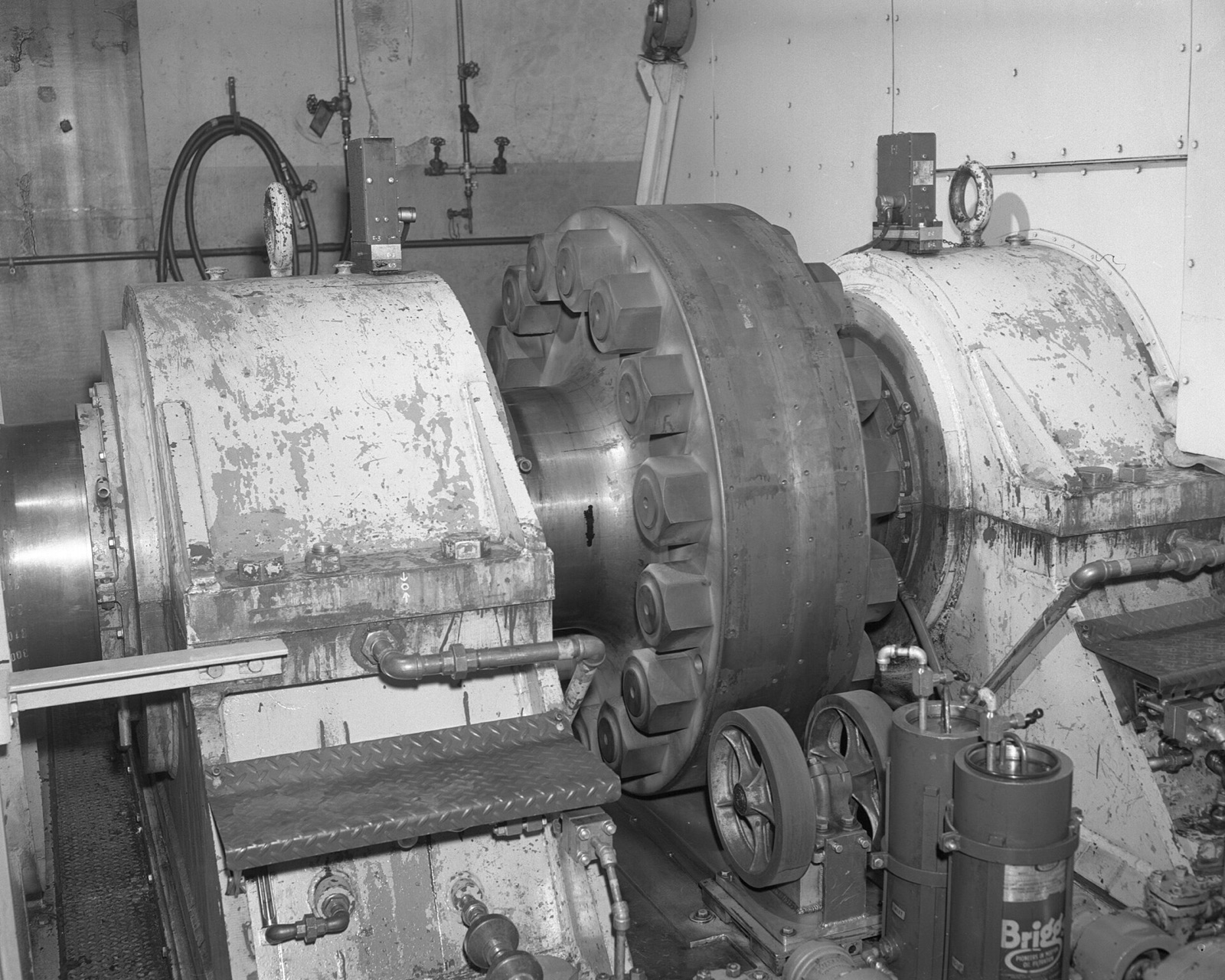
Large motor-generator flywheel assembly at Lawrence Berkeley Laboratory in 1961.

A flywheel stores energy in distributed rotating mass

The wheel stores rotational kinetic energy throughout its mass distribution. Reversing the rotation changes angular velocity’s sign but not the stored kinetic energy.

Use this visual to see
Connect rotational kinetic energy to both inertia and angular speed.
What it cannot show
The photograph does not give rotational inertia, angular speed, stored energy, power rating, or operating direction.

Integrate the particle energies

  1. Write dK=12v2 dmdK=\tfrac12v^2\,dm.
  2. Use rigid-body kinematics v=rωv=r\omega.
  3. Factor out ω2\omega^2 and identify I=∫r2 dmI=\int r^2\,dm.
Result
Krot=∫12(rω)2 dm=12Iω2K_{rot}=\int \frac12(r\omega)^2\,dm=\frac12I\omega^2
Units: II in kg m2^2, ω\omega in rad/s, and KK in J

Boundary cases

  • r=0r=0 mass contributes to total mass but not to II about that axis.
  • The center-of-mass decomposition requires IcmI_{cm}, not an arbitrary parallel-axis inertia.

Each radial mass bin contributes one-half times its mass times squared radius times squared angular speed.

Build a complete kinetic-energy ledger

  1. Choose the inertial frame and axis.
  2. Decide whether the center of mass translates.
  3. Evaluate II about the center of mass for the rotational term.
  4. Add translational and rotational terms once each.
  5. Check the stated fixed quantity before making a factor comparison.

Keep these three ideas

  • Rotational energy is the integral of every mass element’s translational energy.
  • KrotK_{rot} is scalar and unchanged when the direction of rotation reverses.
  • Planar rigid-body motion can require both center-of-mass translation and rotation.
  • Fixed-ω\omega and fixed-LL comparisons produce opposite inertia trends.

Keep reading Unit 6: Energy and Momentum of Rotating Systems

You just read the first topic free. Your free trial opens the rest of this unit, every AP Physics C: Mechanics unit, and all 19 AP courses.

  • 6.1 Rotational Kinetic EnergyRead
  • 6.2 Torque and Work
  • 6.3 Angular Momentum and Angular Impulse
  • 6.4 Conservation of Angular Momentum
  • 6.5 Rolling
  • 6.6 Motion of Orbiting Satellites
Start my free 7 days →$0.00 due today · cancel anytime · score guarantee

Practice AP Physics C: Mechanics in the real test engine.

Free practice set: timed, the same engine as our full-length tests, every answer explained.