Now readingIntroduction
0%
AP Physics C: Mechanics · Framework 2026-27
Unit 7

Oscillations

Simple harmonic motion emerges from a linear restoring law, producing sinusoidal motion whose phase, period, and energy follow from a second-order differential equation.

Exam weight
10–15%
Topics
5

Introduction

Simple harmonic motion emerges from a linear restoring law, producing sinusoidal motion whose phase, period, and energy follow from a second-order differential equation.

An oscillation is simple harmonic only when acceleration is proportional and opposite to displacement from equilibrium. That physical condition creates the differential equation x¨+ω2x=0\ddot x+\omega^2x=0 and its sinusoidal family of solutions. Initial conditions choose the amplitude and phase; system parameters choose the natural frequency.

Energy offers a second description of the same motion, while pendulums show where approximation matters. A gravitational pendulum is exactly nonlinear and becomes SHM only at small angle. Physical and torsion pendulums extend the same restoring-torque logic to rigid bodies.

01
Linear restoring law

SHM differential equation

02
System parameters

natural frequency and period

03
Initial conditions

amplitude and phase

04
Position in the cycle

kinetic and potential energy

05
Small-angle or torsion model

pendulum timing

Current exam guidance: Aligned to the current 2026–27 AP Physics C: Mechanics framework, with calculus-based modeling, derivations, experimental reasoning, and explicit assumptions.
7.1

Defining Simple Harmonic Motion (SHM)

What mathematical condition makes an oscillation simple harmonic?

Short answer

SHM requires a=−ω2xa=-\omega^2x, so acceleration is linear in displacement from equilibrium and always points back toward equilibrium.

Know firstNewton’s second law · Hooke’s law · Second-order differential equations

The restoring law defines the model

Equilibrium is the position where the net force is zero. Measure xx from that position, not from an arbitrary origin. For an ideal spring, Fx=−kxF_x=-kx. Newton’s second law gives mx¨=−kxm\ddot x=-kx, or x¨+(k/m)x=0\ddot x+(k/m)x=0. Comparing with a=−ω2xa=-\omega^2x identifies ω=k/m\omega=\sqrt{k/m}. The negative sign makes the acceleration restorative: positive displacement produces negative acceleration and vice versa.

The differential equation admits x(t)=Acos⁡(ωt+ϕ)x(t)=A\cos(\omega t+\phi) because differentiating twice returns −ω2x-\omega^2x. The constants AA and ϕ\phi come from the initial position and velocity. They describe which member of the solution family occurs; they do not change the system’s ideal natural frequency.

Periodicity alone is insufficient. A pendulum at large angle, a nonlinear spring, and a damped oscillator may repeat or nearly repeat without satisfying a constant proportionality between acceleration and displacement. At equilibrium the acceleration is zero, but speed is generally largest—not zero.

Physics model

Simple harmonic motion has a linear restoring acceleration

Move the oscillator through equilibrium and compare displacement with its opposite acceleration.

Displacement
0.6 m
Acceleration for ω=2\omega=2
-2.4 m/s²
equilibriumdisplacementrestoring acceleration
Simple harmonic motion has a linear restoring accelerationMove the oscillator through equilibrium and compare displacement with its opposite acceleration.equilibrium
a=−ω2xa=-\omega^2x
Read this figure without the graphic

Move the oscillator through equilibrium and compare displacement with its opposite acceleration.

Current quantityValue
Displacement0.6 m
Acceleration for ω=2\omega=2-2.4 m/s²
Model relationa=−ω2xa=-\omega^2x
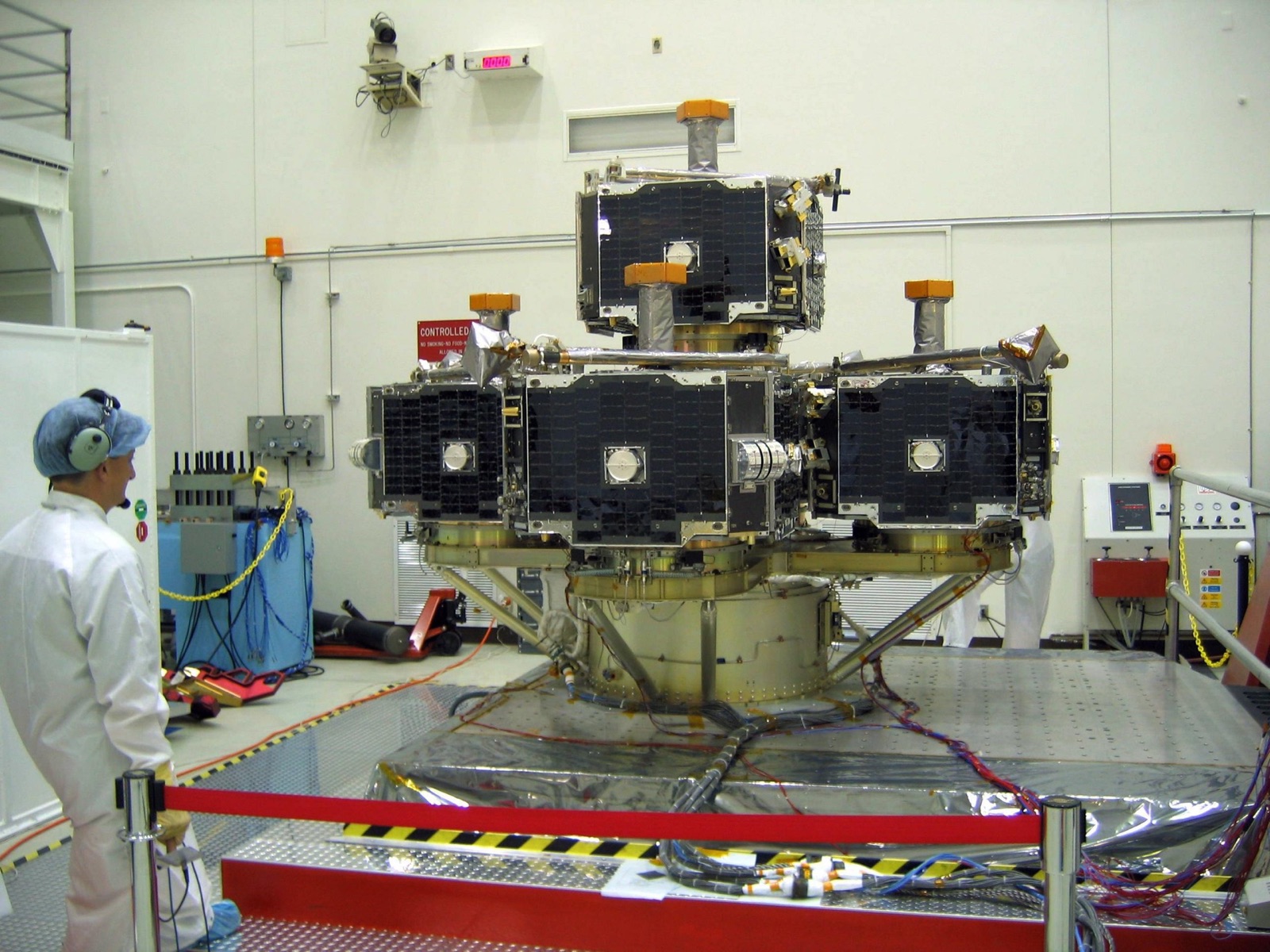
Five THEMIS spacecraft probes mounted together during a vibration test.

A vibration test probes a structure’s oscillatory response

A controlled vibration test drives the spacecraft through specified motions and measures its response. Simple harmonic motion is one ideal model; real structures can have many coupled modes and damping.

Use this visual to see
Place the linear restoring-force model inside a real structural test.
What it cannot show
The image does not show displacement-time data, mode shapes, frequencies, damping, applied force, or whether the motion is simple harmonic.

Read the sinusoidal solution family

  1. Rewrite the motion law in the SHM form x¨=−ω2x\ddot x=-\omega^2x.
  2. Identify ω2=k/m\omega^2=k/m from the coefficient of displacement.
  3. Use initial position and velocity to select AA and ϕ\phi from the known sinusoidal solution family.
Result
x=Acos⁡(ωt+ϕ),ω=kmx=A\cos(\omega t+\phi),\qquad \omega=\sqrt{\frac{k}{m}}
Units: xx and AA in m, ω\omega in rad/s, kk in N/m

Boundary cases

  • A=0A=0 is the equilibrium solution.
  • A force containing significant x2x^2 or x3x^3 terms is not exact SHM.

The spring equation identifies the natural angular frequency, while the initial state selects one cosine curve from the solution family.

Classify an oscillator

  1. Locate equilibrium and define displacement from it.
  2. Write net force or acceleration as a function of displacement.
  3. Check for a straight line through the origin with negative slope.
  4. Identify the physical range over which that linear law holds.
  5. Read ω2\omega^2 from the magnitude of the acceleration–position slope.

Keep these three ideas

  • SHM is defined by a linear, opposite acceleration–displacement relation.
  • The sinusoidal solution follows from the second-order differential equation.
  • Amplitude and phase come from initial conditions, not system stiffness alone.

Keep reading Unit 7: Oscillations

You just read the first topic free. Your free trial opens the rest of this unit, every AP Physics C: Mechanics unit, and all 19 AP courses.

  • 7.1 Defining Simple Harmonic Motion (SHM)Read
  • 7.2 Frequency and Period of SHM
  • 7.3 Representing and Analyzing SHM
  • 7.4 Energy of Simple Harmonic Oscillators
  • 7.5 Simple and Physical Pendulums
Start my free 7 days →$0.00 due today · cancel anytime · score guarantee

Practice AP Physics C: Mechanics in the real test engine.

Free practice set: timed, the same engine as our full-length tests, every answer explained.