Expansion, Civil War, and Reconstruction
Territorial expansion made the status of slavery harder to postpone. Civil war destroyed slavery and expanded federal authority; Reconstruction created constitutional citizenship and biracial political institutions but failed to secure those changes against organized violence and retreating national enforcement.
- Exam weight
- 10–17%
- Topics
- 12
- Visual studies
- 4
Why did expansion destroy compromise and make Reconstruction necessary?
Territorial growth repeatedly reopened whether slavery could expand.
Secession and war transformed federal power and destroyed slavery.
Reconstruction attempted to build citizenship and biracial government but faced organized counterrevolution.
How the changes connect
- Expansion raises the stakes of slavery
- Party and judicial systems lose legitimacy
- War joins Union to emancipation
- Enforcement determines postwar citizenship
Compare the cases
| Case | How it worked | What made it distinct |
|---|---|---|
| Revolution | Republican sovereignty | Social hierarchy largely survives |
| Civil War | Union and emancipation | National military and fiscal expansion |
| Reconstruction | Citizenship amendments | Rights dependent on protection |
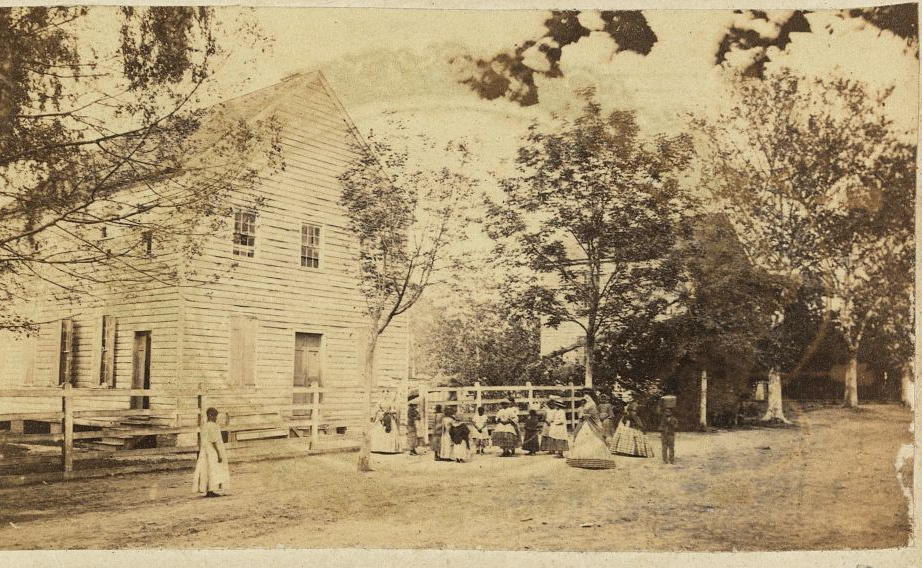
Read the chapter image
What does the scene reveal about freedom as a practical project rather than only a legal declaration?
Contextualizing Period 5
Why did territorial growth turn slavery into an immediate crisis?
By 1844, cotton expansion, abolition, western migration, party competition, and the unresolved status of new territory made continued ambiguity over slavery increasingly unstable.
Annexation added a slaveholding republic and sharpened conflict with Mexico. Expansion connected foreign policy to sectional balance. Black and white activists made slavery a persistent moral and political issue. Organized criticism narrowed the space for silence.
Many northerners opposed slavery’s western expansion as a threat to independent white labor. Antislavery politics did not always rest on racial equality. Expansion caused crisis because every new territory forced a decision about slavery and the political power attached to it.
Evidence worth keeping
Know what each example demonstrates, not only its name.
Texas annexation
- What happened
- Annexation added a slaveholding republic and sharpened conflict with Mexico.
- What it proves
- Expansion connected foreign policy to sectional balance.
- Use it for
- Use Texas annexation as direct support for the topic’s main relationship. Begin with the action or policy, name the people or institution making the choice, and then explain the result: Expansion connected foreign policy to sectional balance. Pair it with Abolitionist organizing if the prompt asks you to weigh more than one cause.
- Do not overclaim
- Texas annexation shows that Expansion connected foreign policy to sectional balance. It remains one bounded example and cannot represent every region or group.
Abolitionist organizing
- What happened
- Black and white activists made slavery a persistent moral and political issue.
- What it proves
- Organized criticism narrowed the space for silence.
- Use it for
- This case helps you move from example to pattern. Set Abolitionist organizing beside Texas annexation, identify one shared measure, and explain the difference in policy, setting, or power that affected the outcome. Keep the comparison tied to the claim: Organized criticism narrowed the space for silence.
- Do not overclaim
- Abolitionist organizing shows that Organized criticism narrowed the space for silence. It remains one bounded example and cannot represent every region or group.
Free-labor ideology
- What happened
- Many northerners opposed slavery’s western expansion as a threat to independent white labor.
- What it proves
- Antislavery politics did not always rest on racial equality.
- Use it for
- Free-labor ideology is the evidence to use when the first two cases make the argument sound too broad. Explain the apparent exception, then decide whether it weakens the claim or narrows its scope. The key analytical point is that antislavery politics did not always rest on racial equality.
- Do not overclaim
- Free-labor ideology shows that Antislavery politics did not always rest on racial equality. It remains one bounded example and cannot represent every region or group.
Use on the exam
Expansion caused crisis because every new territory forced a decision about slavery and the political power attached to it.
Do not assume all opponents of expansion supported abolition or equal rights.
Bottom line: Build the paragraph around the relationship between Texas annexation and Abolitionist organizing; use Free-labor ideology to qualify how widely the explanation applies. A sound response should establish the relationship with Texas annexation, check it against Abolitionist organizing, and use Free-labor ideology only for the limit it can actually prove. State the causal verb directly instead of leaving the reader to infer why the cases belong together.