Conflict, Crisis, and Reaction in the Late 18th Century
Eighteenth-century states gained power through war, credit, commerce, and empire but became vulnerable when privilege blocked reform. France’s fiscal crisis became a sovereignty struggle; popular action, war, and mistrust radicalized it, while Napoleon and Vienna joined revolutionary changes to new forms of order.
- Exam weight
- 10–15%
- Topics
- 9
- Visual studies
- 4
How did state strength produce revolutionary vulnerability?
Eighteenth-century rulers expanded war, commerce, taxation, and empire while retaining privileged exemptions and unequal representation.
In France, fiscal deadlock opened a sovereignty dispute that popular mobilization transformed in 1789.
War and counterrevolution radicalized the republic; Napoleon spread legal-administrative change through empire before the Vienna powers rebuilt order.
How the changes connect
- War and credit increase state power and debt
- Privilege blocks legitimate fiscal reform
- Assembly and crowd action transfer sovereignty
- War expands emergency government and imperial rule
Compare the cases
| Case | How it worked | What made it distinct |
|---|---|---|
| French Revolution | Citizenship and legal equality for men | Rapid phase changes and contested sovereignty |
| Napoleonic Empire | Codification and administration through conquest | Reform joined to military domination |
| Vienna settlement | Great-power consultation and restoration | Order without full return to 1788 |
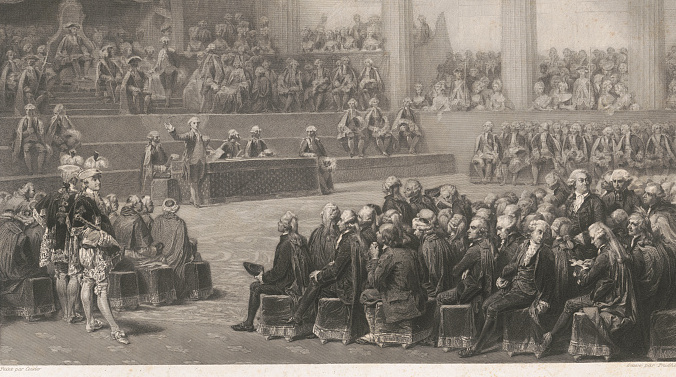
Read the chapter image
How does the room organize political rank, and what conflict is difficult to see in the ceremony?
Contextualizing 18th-Century States
Why did stronger eighteenth-century states face unusually deep political crises?
Fiscal-military states could borrow, tax, administer, and fight at greater scale, but their revenue systems preserved corporate and estate privilege. Commerce and empire brought wealth alongside debt and vulnerability, while print and representation widened arguments over consent.
Repeated wars required borrowing, taxation, supply systems, and administrative growth; defeat or credit pressure could expose the gap between commitments and dependable revenue. Greater war capacity could create a larger fiscal burden. Nobles, clergy, provinces, guilds, and officeholders defended exemptions or corporate rights that rulers needed either to negotiate with or overcome. Privilege made apparently technical tax reform a constitutional conflict.
Pamphlets, newspapers, assemblies, courts, and public controversy gave organized groups languages and venues for challenging policy and legitimacy. Fiscal strain became crisis where institutions made consent contestable. Stronger states faced deep crises because war enlarged their financial demands while privilege blocked reform and public institutions converted distributional disputes into arguments over political authority.
Evidence worth keeping
Know what each example demonstrates, not only its name.
War debt
- What happened
- Repeated wars required borrowing, taxation, supply systems, and administrative growth; defeat or credit pressure could expose the gap between commitments and dependable revenue.
- What it proves
- Greater war capacity could create a larger fiscal burden.
- Use it for
- Use War debt as direct support. Name the actor, action, result, and the link between them.
- Do not overclaim
- War debt shows that Greater war capacity could create a larger fiscal burden. It remains one bounded example and cannot represent every region or group.
Estate privilege
- What happened
- Nobles, clergy, provinces, guilds, and officeholders defended exemptions or corporate rights that rulers needed either to negotiate with or overcome.
- What it proves
- Privilege made apparently technical tax reform a constitutional conflict.
- Use it for
- Pair Estate privilege with War debt. Hold the question constant—power, labor, citizenship, markets, or another relevant category—and explain whether the second case confirms the same mechanism or changes it. The useful inference is that privilege made apparently technical tax reform a constitutional conflict.
- Do not overclaim
- Estate privilege shows that Privilege made apparently technical tax reform a constitutional conflict. It remains one bounded example and cannot represent every region or group.
Print and representative politics
- What happened
- Pamphlets, newspapers, assemblies, courts, and public controversy gave organized groups languages and venues for challenging policy and legitimacy.
- What it proves
- Fiscal strain became crisis where institutions made consent contestable.
- Use it for
- A qualified paragraph can end with Print and representative politics. Contrast its setting or outcome with War debt, then state what the difference prevents you from claiming. The evidence still belongs in the argument because fiscal strain became crisis where institutions made consent contestable.
- Do not overclaim
- Print and representative politics shows that Fiscal strain became crisis where institutions made consent contestable. It remains one bounded example and cannot represent every region or group.
Use on the exam
Stronger states faced deep crises because war enlarged their financial demands while privilege blocked reform and public institutions converted distributional disputes into arguments over political authority.
Do not treat fiscal pressure as automatic revolution or assume every European monarchy shared the French path.
Bottom line: Build the paragraph around the relationship between War debt and Estate privilege; use Print and representative politics to qualify how widely the explanation applies. Prioritize explanation over name-dropping: connect War debt to Estate privilege, then state exactly why Print and representative politics confirms, complicates, or limits that connection. The explanation after each example should be longer than the label itself.