Networks of Exchange
Improved commercial practices, transport technologies, and imperial security made old routes busier. More exchange moved goods, beliefs, crops, diseases, and knowledge—with unequal effects across regions.
- Exam weight
- 8–10%
- Topics
- 7
- Visual studies
- 4
Why did exchange accelerate after 1200, and why did its effects reach far beyond merchants?
Trade expanded when several conditions reinforced one another. Large states and the Mongol conquests secured key routes; merchants used credit, partnerships, bills of exchange, and diaspora communities to reduce risk; caravanserai and port cities supplied lodging, information, and markets; and transport technologies made particular environments more usable. No single invention “created” the Silk Roads or Indian Ocean system. The historical explanation is a network of political protection, commercial institutions, environmental knowledge, and demand for valuable goods.
Each route had a different logic. Overland Silk Roads favored compact luxury goods because every border, caravan, and middleman added cost. Indian Ocean shipping could carry bulkier cargo, but sailors had to understand monsoon cycles and connect through specialized ports. Trans-Saharan caravans depended on camel transport, desert knowledge, and demand for West African gold. Treating all trade as one generic system throws away the comparison the exam often asks students to make.
Exchange reshaped societies because travelers carried more than cargo. Merchant diasporas, pilgrims, scholars, and conquerors moved languages, religions, technologies, and artistic forms. Crops changed diets and population patterns. Disease traveled too: the Black Death exposed the biological cost of dense interconnection. The highest-value explanation names both the carrier and the local response; ideas were translated, blended, resisted, or repurposed rather than simply copied.
How the changes connect
- Political stability lowers some travel risks
- Commercial tools let merchants operate across distance
- Transport and environmental knowledge widen capacity
- Repeated movement circulates goods, beliefs, crops, and pathogens
Compare the cases
| Case | How it worked | What made it distinct |
|---|---|---|
| Silk Roads | Overland; luxury goods; many political boundaries | Caravans and high value-to-weight cargo |
| Indian Ocean | Maritime; seasonal winds; large port network | Monsoon knowledge and merchant diasporas |
| Trans-Saharan | Desert crossing; gold, salt, and other goods | Camel caravans linked West Africa to North Africa |
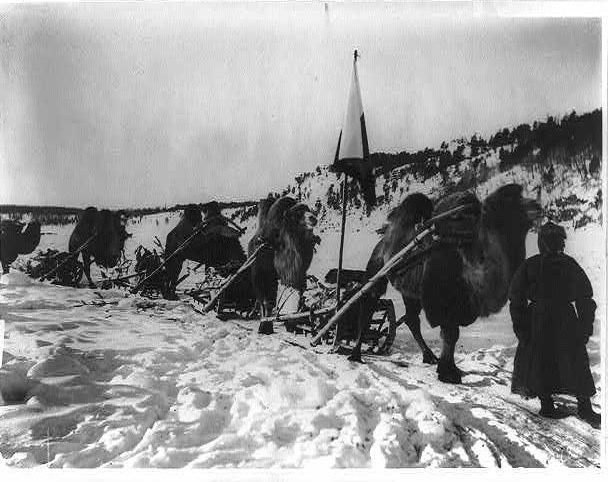
Read the chapter image
Which features of this animal made overland exchange more practical, and why should the image not be treated as direct evidence of medieval trade volume?
The Silk Roads
Why did Silk Road trade favor luxury goods and a chain of regional merchants?
Silk Roads linked East Asia, Central Asia, the Islamic world, and Europe through relay trade rather than one continuous trip. Caravanserai, credit, bills of exchange, and powerful trading cities reduced cost and risk. Because land transport was expensive, merchants favored compact luxury goods such as silk, porcelain, horses, and spices.
The Silk Roads worked as connected segments. A good could pass through several merchants, currencies, and political jurisdictions before reaching a distant buyer. High land-transport costs favored items with a high value relative to weight, while credit and caravanserai reduced—but never removed—the uncertainty of long-distance exchange.
Price explains the cargo: Imagine paying for pack animals, guards, food, tolls, and losses at every stage. A bulky low-value crop may cost more to move than it earns, while silk, gems, fine ceramics, or spices can absorb those expenses. Geography therefore helps determine what becomes a long-distance good.
Evidence worth keeping
Know what each example demonstrates, not only its name.
Caravanserai
- What happened
- Caravanserai provided protected lodging, food, storage, animals, and information at intervals along overland routes. They reduced some risks of travel and created places where merchants from different regions could exchange goods and news.
- What it proves
- Commercial infrastructure made repeated long-distance exchange more dependable without eliminating distance, tolls, or political danger.
- Use it for
- Causes of expanding trade or the role of institutions in reducing transaction costs.
- Do not overclaim
- A caravanserai supported one segment of a route; it did not create a single uninterrupted road from China to Europe.
Bills of exchange and credit
- What happened
- Merchants used credit arrangements and written promises of payment so they did not need to carry all their wealth in coin. Commercial partnerships distributed investment and risk among people connected by family, religion, reputation, or law.
- What it proves
- Financial tools addressed the danger and inconvenience of moving money across long distances.
- Use it for
- Commercial innovation, trust networks, or comparison with later banking systems.
- Do not overclaim
- Terms and enforcement differed by region; avoid describing one universal banking system.
Luxury-goods relay trade
- What happened
- Silk, porcelain, gemstones, horses, and spices could survive high costs for animals, guards, tolls, and middlemen because they carried substantial value in relatively little weight. Goods often changed hands repeatedly rather than remaining with one merchant for the entire trip.
- What it proves
- Transport cost shaped both the cargo and the segmented structure of overland exchange.
- Use it for
- Geographic causation or comparison with bulk shipping in the Indian Ocean.
- Do not overclaim
- The routes also moved ordinary goods locally; the luxury pattern applies most clearly to very long-distance trade.
Use on the exam
Silk Road commerce expanded because political protection, caravan infrastructure, and credit reduced risk, while high land-transport costs favored valuable, compact goods exchanged through regional relays.
Most merchants traveled only part of the network.
Bottom line: Explain the cost of movement before listing what merchants carried.