Transoceanic Interconnections
European states connected Atlantic and Pacific routes to older commercial systems. The result was not merely “exploration”: it was conquest, forced labor, ecological transfer, new racial hierarchies, and a global circulation of silver.
- Exam weight
- 12–15%
- Topics
- 8
- Visual studies
- 4
How did oceanic connection reorganize economies, environments, and human lives?
European oceanic expansion grew from a particular mix of motives and capacity: demand for Asian goods, competition among states, religious ambition, navigational knowledge, and investment in armed ships. Iberian voyages opened durable Atlantic links and a sea route around Africa, but Europeans entered an Indian Ocean commercial world that already had experienced merchants, ports, and political powers. They gained leverage selectively through fortified trading posts, naval violence, and alliances before controlling large inland territories.
The Atlantic system developed differently. Conquest in the Americas, the demographic collapse of Indigenous populations, plantation demand, and mining created enormous labor needs. Colonizers used Indigenous coerced labor and expanded the transatlantic trade in enslaved Africans. Silver linked American mines to European finance and Chinese demand, while joint-stock companies and mercantilist policies connected private capital with state power.
The Columbian Exchange was biological as well as commercial. American crops supported population growth in parts of Afro-Eurasia; imported animals and plants transformed American landscapes; pathogens killed on a catastrophic scale where populations lacked prior exposure. Cultural mixing, resistance, and new racial classifications developed inside these unequal systems. “Exchange” describes movement, not fairness.
How the changes connect
- Maritime capacity and rivalry produce sustained crossings
- Conquest and disease disrupt American societies
- Mining and plantations intensify coerced labor
- Commodities, silver, organisms, and people bind ocean basins together
Compare the cases
| Case | How it worked | What made it distinct |
|---|---|---|
| Trading-post empire | Control of ports, routes, and commerce | Limited inland rule; strong naval and company role |
| Territorial colony | Direct rule over land and populations | Settlers, officials, and coercive labor institutions |
| Global commodity chain | Production, finance, transport, and consumption in different regions | Silver and sugar reveal the system especially clearly |
Read the chapter image
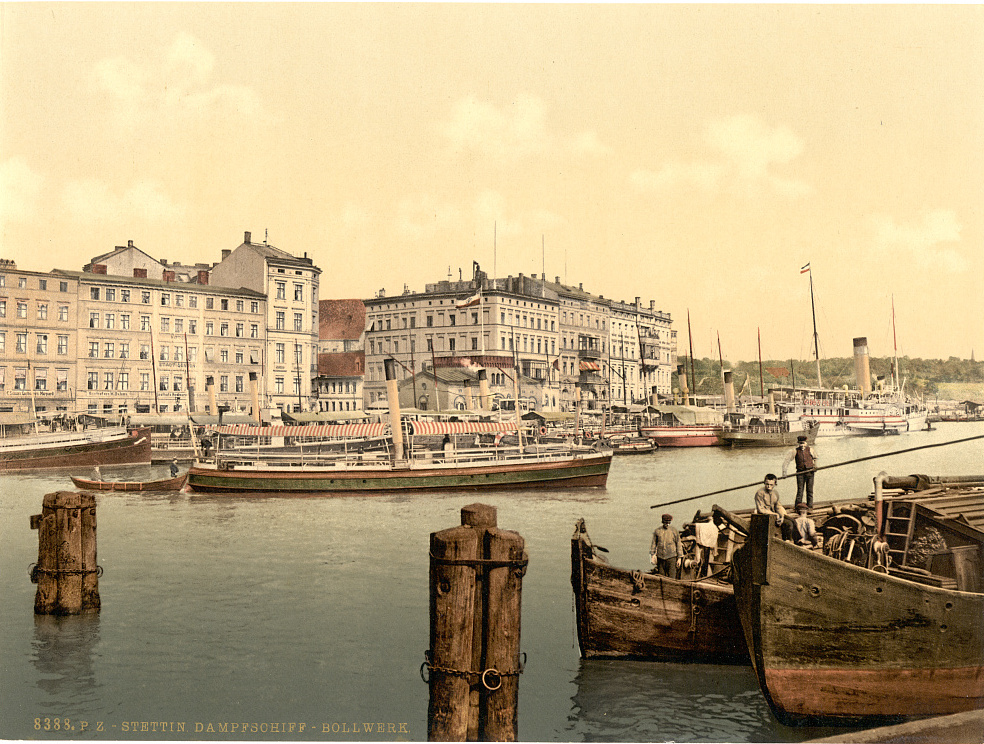
Which systems beyond the ships are visible here, and which early modern institutions would you need to supply from outside knowledge?
Technological Innovations
How did sailors combine knowledge from several regions to make oceanic voyages more reliable?
Mariners combined the magnetic compass, improved charts, astronomical navigation, and ship designs suited to different waters. Much knowledge had roots in Chinese, Islamic, Mediterranean, and Indian Ocean traditions. European states and investors assembled these tools into sustained Atlantic ventures.
Oceanic voyaging became more reliable when navigators combined ship design, sail plans, magnetic direction, astronomical observation, charts, and accumulated route knowledge. Many elements had histories in Asian, Mediterranean, and Islamic maritime worlds. European states assembled and financed them for sustained Atlantic and Indian Ocean competition.
Innovation through combination: A compass helps with direction, an astrolabe or other observations help estimate position, and a caravel’s rigging helps sailors work with changing winds. None solves every problem alone. The breakthrough is a package of tools plus crews trained to use them.
Evidence worth keeping
Know what each example demonstrates, not only its name.
The magnetic compass
- What happened
- The magnetic compass developed in China and spread through maritime exchange into the Indian Ocean, Islamic world, and Europe. It gave sailors a dependable directional reference when clouds, darkness, or distance from shore made visual navigation difficult.
- What it proves
- Oceanic innovation often came from borrowing and adapting knowledge rather than inventing every component locally.
- Use it for
- Technological diffusion or causation in European maritime expansion.
- Do not overclaim
- A compass indicates direction, not exact position, and could not replace charts, experience, or knowledge of winds and currents.
Astronomical instruments and charts
- What happened
- Mariners used instruments such as the astrolabe and cross-staff, together with portolan charts and accumulated observations, to estimate latitude and plan routes. Much of the relevant mathematical and astronomical learning moved through Mediterranean and Islamic scholarly networks.
- What it proves
- Reliable navigation emerged from a system of measurement, recorded knowledge, and trained interpretation.
- Use it for
- Knowledge transfer or explanation of how states reduced the risk of long voyages.
- Do not overclaim
- Early modern sailors could not determine longitude accurately at sea, and surviving maps often contained major errors.
Caravels and carracks
- What happened
- Portuguese and Spanish shipbuilders combined hull forms and sail plans suited to different tasks. Caravels were maneuverable for exploration, while larger carracks carried more supplies, cargo, and weapons on long voyages.
- What it proves
- Ship design helped states sustain voyages by balancing maneuverability, capacity, range, and military force.
- Use it for
- Maritime technology, state-sponsored exploration, or comparison with Indian Ocean vessels.
- Do not overclaim
- European ships incorporated older Mediterranean and Atlantic practices and did not instantly outperform every vessel in every setting.
Use on the exam
European oceanic expansion depended on recombining the compass, astronomical knowledge, charts, and adaptable ships into a navigational system financed and used by competing states.
Do not credit all navigation technology to Europe.
Bottom line: The important innovation was the working package of knowledge, ships, crews, and finance—not one miraculous device.