Consequences of Industrialization
Industrial demand, strategic rivalry, and racial ideology drove a new wave of imperial expansion. Colonized regions were reorganized to supply raw materials and labor, and millions of migrants moved within and across empires.
- Exam weight
- 12–15%
- Topics
- 8
- Visual studies
- 4
How did industrial power become imperial control, and how did people maneuver inside that pressure?
Industrial capacity changed what states could project overseas. Steam transport, telegraphs, modern weapons, finance, and medicine reduced some of the costs of distant conquest. Economic demand for raw materials and markets, strategic rivalry, missionary projects, and racial ideologies supplied motives and justification. These causes interacted: industry provided means, competition directed attention, and ideology defended domination.
Imperial rule took multiple forms. A colony involved formal political control, but protectorates, spheres of influence, concessions, company rule, and creditor pressure could restrict sovereignty without complete annexation. Railroads and ports might increase movement while also channeling mines or plantations toward export. Infrastructure must therefore be read by route, ownership, purpose, and distribution of benefit—not labeled automatically as either “progress” or “exploitation.”
Subject peoples were not passive. They fought, negotiated, selectively reformed, collaborated, migrated, and built new political or religious movements. Outcomes depended on state cohesion, access to weapons, geography, diplomacy, and internal division. Migration likewise ran along a spectrum from forced to constrained to voluntary, and its effects appeared at both ends: remittances and demographic change, diaspora culture and nativist backlash.
How the changes connect
- Industrial tools expand the reach of states and firms
- Economic and strategic rivalry selects targets
- Legal and racial ideologies justify unequal rule
- Resistance, reform, and migration reshape imperial outcomes
Compare the cases
| Case | How it worked | What made it distinct |
|---|---|---|
| Formal empire | Foreign state directly claims political rule | Colonial officials and territorial sovereignty |
| Economic imperialism | Debt, ownership, concessions, or trade rules constrain choices | Local flag may remain while leverage shifts outward |
| Settler colonialism | Large settler population seeks land and durable political dominance | Displacement becomes a central process |
Read the chapter image
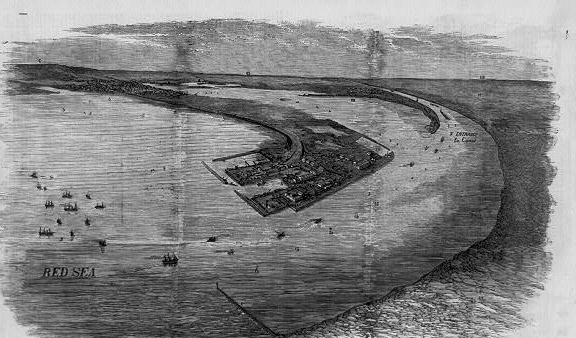
Which economic and military interests would value this canal, and how might its location affect Egyptian sovereignty?
Rationales for Imperialism
How did imperial powers present economic and strategic conquest as moral progress?
Industrial states sought raw materials, markets, investment opportunities, strategic routes, and national prestige. Missionaries and officials claimed a civilizing duty, while Social Darwinist and racist ideas falsely presented domination as natural. These rationales justified policies rooted in power and profit.
Imperialism joined motives to means and justification. Industrial states sought markets, materials, strategic routes, prestige, and security; steam power, medicine, communications, and weapons lowered some costs of projection; racial and civilizing ideologies presented domination as natural or beneficial. No single motive explains every conquest.
Separate what enabled from what directed: A steamship can move troops and officials, but it does not choose a target. Strategic rivalry or commercial interest helps explain where power is applied, while ideology helps defend that application to domestic and international audiences. Strong causation assigns each factor a job.
Evidence worth keeping
Know what each example demonstrates, not only its name.
Raw materials and markets
- What happened
- Industrial firms and governments sought cotton, rubber, palm oil, minerals, and other inputs, along with customers and investment opportunities. Control over territory or commercial rules could secure supplies and exclude rival powers.
- What it proves
- Industrial economies created material incentives for expansion, especially when states treated access as a strategic competition.
- Use it for
- Economic motives for imperialism or connection between Units 5 and 6.
- Do not overclaim
- Not every colony was profitable, and expectations of gain sometimes mattered more than the revenue ultimately collected.
Strategic rivalry
- What happened
- States valued coaling stations, naval bases, canals, river routes, and buffer territories that protected trade or existing possessions. British interest in Egypt, for example, was closely connected to the Suez Canal and routes toward India.
- What it proves
- Imperial expansion could be driven by the military value of location even when immediate commercial returns were uncertain.
- Use it for
- Geopolitics, state rivalry, or analysis of chokepoints.
- Do not overclaim
- Strategic language could conceal private commercial interests or domestic political motives; sources must be evaluated by speaker and audience.
Civilizing mission and Social Darwinism
- What happened
- Imperial advocates claimed that conquest would spread Christianity, education, medicine, technology, or “civilization.” Social Darwinist arguments misapplied ideas of competition and evolution to rank peoples and portray domination as natural.
- What it proves
- Racial and humanitarian rhetoric made unequal rule easier to justify to imperial audiences and officials.
- Use it for
- Ideological motives, source analysis, or the legitimization of coercion.
- Do not overclaim
- Stated benevolence does not establish actual motive or effect; compare rhetoric with labor, land, and political policy.
Use on the exam
Industrial demand and strategic rivalry encouraged imperial expansion, while racial and civilizing claims recast coercive control as a duty or natural hierarchy.
Do not accept an empire’s stated humanitarian purpose as the complete cause.
Bottom line: Separate what empire promised from what its policies extracted and whom they empowered.