Global Conflict
Industrial states mobilized entire societies for two world wars. Imperial rivalry, nationalism, alliance systems, economic crisis, extremist ideology, and unresolved settlements transformed war into mass violence against soldiers and civilians.
- Exam weight
- 8–10%
- Topics
- 9
- Visual studies
- 4
How did industrial states turn rivalry into total war and mass violence?
World War I requires a layered explanation. National and imperial rivalry, alliance commitments, military planning, and arms buildup created a dangerous structure; assassination created a crisis; leaders’ decisions and mobilization timetables spread it. The trigger is not the whole cause, and the acronym MAIN is not an argument until it explains interaction and relative importance.
Industrial firepower changed the conduct of war. Machine guns, artillery, trenches, rail supply, submarines, and chemical weapons made killing more scalable while often favoring defense. States mobilized factories, colonial troops, food, credit, media, and women’s labor. The home front became part of the military system, and civilians became more exposed to blockade, occupation, famine, propaganda, and attack.
The peace did not resolve every conflict. Uneven self-determination, penalties, border disputes, war debt, and later depression weakened political systems. Fascist and militarist regimes pursued expansion, while appeasement and weak collective security failed to restrain them. World War II fused mechanized war, racial empire, strategic bombing, forced labor, genocide, and atomic attack. Mass atrocity was enabled through policy, bureaucracy, dehumanization, and institutions—not spontaneous hatred alone.
How the changes connect
- Rivalries and military systems load the crisis
- Political decisions turn a trigger into wider war
- States mobilize economies, empires, and civilians
- Ideology and administrative power intensify violence against targeted groups
Compare the cases
| Case | How it worked | What made it distinct |
|---|---|---|
| World War I | Alliance escalation and mobilization turned a regional crisis general | Industrial defense contributed to prolonged stalemate |
| World War II | Expansionist regimes pursued deliberate territorial and racial projects | Mechanized movement and attacks on civilians widened the conflict |
| Both | Great-power rivalry, industrial capacity, mass mobilization | Shared ingredients carried different causal weight |
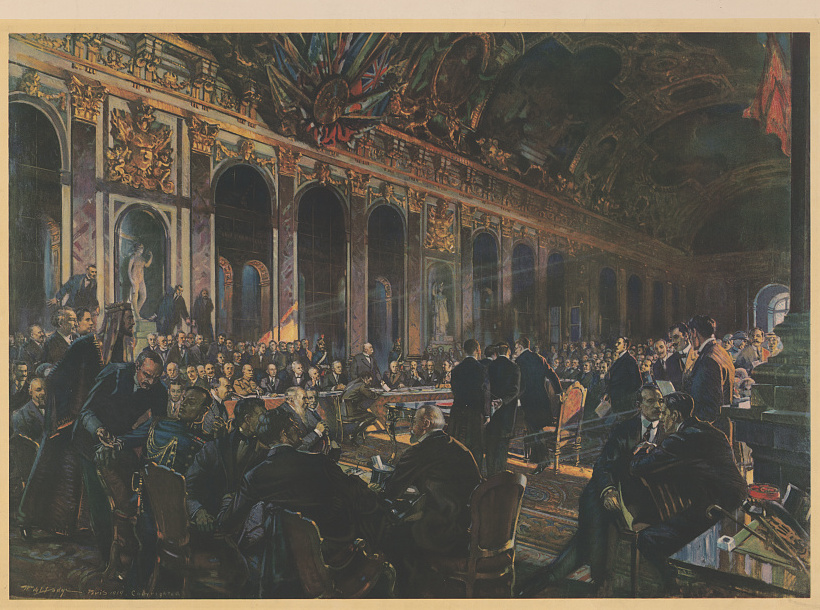
Read the chapter image
Which voices appear institutionally powerful in this scene, and which populations affected by the settlement are difficult to locate?
Shifting Power After 1900
How did global power move away from older land empires after 1900?
The Ottoman, Qing, and Russian empires weakened or collapsed amid war, revolution, and nationalist pressure. Japan and the United States grew in influence, while anticolonial movements challenged European dominance. The 1917 Bolshevik Revolution created a communist state with a new economic and political model.
Power shifted because industrial capacity, state reform, empire, and war changed at different rates. Japan built a modern military and industrial state; the Ottoman, Russian, and Qing empires faced internal and external pressure; the United States expanded economic reach; colonial subjects formed new political movements. Decline and rise were processes, not single dates.
Measure power with several indicators: Territory alone can mislead. Compare manufacturing, tax revenue, military logistics, financial capacity, political cohesion, and the ability to influence rules beyond one’s borders. A large empire may still struggle to mobilize resources, while a smaller industrial state may project force efficiently.
Evidence worth keeping
Know what each example demonstrates, not only its name.
The collapse of land empires
- What happened
- World War I helped destroy the Ottoman, Austro-Hungarian, Russian, and German imperial orders. Successor states claimed national self-determination, but new borders left minorities inside states and placed former Ottoman lands under European mandates.
- What it proves
- War shifted the political map from dynastic empires toward nation-states without solving the problem of diverse populations and competing territorial claims.
- Use it for
- Change in political organization or context for interwar conflict.
- Do not overclaim
- Empire did not disappear: European overseas colonies expanded or survived after 1918.
Japan and the United States
- What happened
- Industrial production, naval growth, overseas expansion, and financial power increased the influence of Japan and the United States. Both participated in the postwar order while pursuing regional interests that challenged older European dominance.
- What it proves
- Power shifted between states as industrial and military capacity grew outside western Europe.
- Use it for
- Global power transition, industrialization, or context for Pacific conflict.
- Do not overclaim
- The two powers had different political systems, regional aims, and relationships to European empires; they should not be treated as parallel in every respect.
The Russian Revolution
- What happened
- War losses, food shortages, political repression, and social conflict brought down the tsar in 1917. Bolsheviks seized power later that year and built a state claiming legitimacy from socialist revolution rather than dynasty or liberal parliament.
- What it proves
- Power shifted not only among states but also toward ideological movements offering new models of political and economic order.
- Use it for
- Revolution, ideological change, or context for the Cold War.
- Do not overclaim
- The revolution was not the inevitable result of Marxist ideas; wartime collapse, organization, leadership, and competing political choices mattered.
Use on the exam
World War I weakened dynastic empires, elevated industrial powers such as Japan and the United States, and opened space for revolutionary states claiming a new ideological basis of rule.
European empires did not vanish in 1918; many colonies remained until after World War II.
Bottom line: Measure power by territory, production, finance, military reach, and ideological influence rather than by one map alone.