Cold War and Decolonization
After 1945, U.S.–Soviet rivalry structured world politics, but decolonization and local movements had their own goals. New states navigated superpower pressure, borders inherited from empire, development challenges, and demands for social change.
- Exam weight
- 8–10%
- Topics
- 9
- Visual studies
- 4
How did local struggles for security and independence interact with a bipolar world?
After 1945, the United States and Soviet Union possessed unmatched military and ideological power, but their rivalry grew from both ideas and security fears. Europe divided into alliance blocs; nuclear weapons encouraged deterrence while raising the cost of miscalculation. Competition spread through aid, coups, arms transfers, propaganda, and proxy wars rather than direct sustained combat between the superpowers.
Local actors had agendas of their own. Communist victory in China drew on peasant organization, war, nationalism, and adapted revolutionary strategy. Conflicts in Korea, Vietnam, Afghanistan, Latin America, Africa, and the Middle East connected to Cold War resources but cannot be explained only as moves made in Washington or Moscow. A strong answer holds the local and global levels together.
Decolonization also took different routes: negotiation, mass protest, armed struggle, international pressure, or combinations of them. European exhaustion created an opening, but organized movements made independence. New states inherited borders, unequal trade positions, development challenges, and internal divisions. Nonalignment was an attempt to preserve choices, not passive neutrality. By 1991, economic strain, reform, nationalist pressure, and political decisions contributed to the Soviet collapse, but decolonization’s unresolved questions continued.
How the changes connect
- World war weakens empires and elevates two superpowers
- Security fears and ideology harden rival blocs
- Local movements use or resist superpower resources
- New states pursue sovereignty amid inherited borders and economic constraints
Compare the cases
| Case | How it worked | What made it distinct |
|---|---|---|
| Negotiated transition | Imperial government and nationalist leadership bargain over transfer | Can still include pressure, violence, and partition |
| Armed struggle | Guerrilla or conventional conflict raises the cost of empire | Often leaves militarized politics and deep destruction |
| Nonalignment | States seek cooperation and autonomy outside formal blocs | Not isolation; members still made pragmatic relationships |
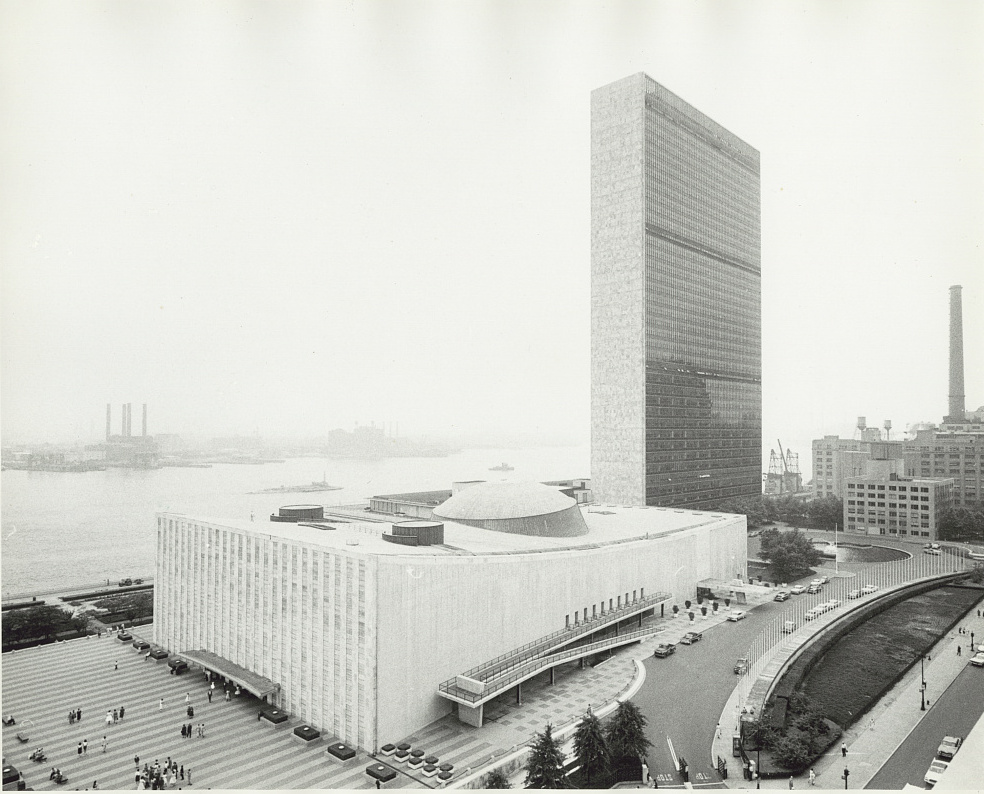
Read the chapter image
How can an international building symbolize cooperation while revealing little about the actual power of its members?
Setting the Stage for the Cold War and Decolonization
How did World War II create both a bipolar rivalry and an opening for decolonization?
World War II weakened European empires and elevated the United States and Soviet Union. Wartime mobilization strengthened anticolonial movements, while the Atlantic Charter and United Nations language raised expectations of self-rule. Soviet and Western distrust grew from ideology, security fears, and conflicting plans for postwar Europe.
World War II weakened European empires while strengthening organized anti-colonial movements and elevating the United States and Soviet Union. Wartime mobilization raised expectations, exposed imperial vulnerability, and spread weapons and political networks. The new United Nations language of sovereignty and rights created leverage even when enforcement remained uneven.
An opening is not the same as independence: European exhaustion reduced the resources available for empire, but movements still had to organize strikes, parties, negotiations, international campaigns, or armed struggle. Structural weakness creates opportunity; collective action converts opportunity into political change.
Evidence worth keeping
Know what each example demonstrates, not only its name.
Weakened European empires
- What happened
- World War II exhausted European finances, damaged infrastructure, and undermined claims that imperial governments could guarantee security. Japan’s wartime conquests also broke the image of permanent European control in parts of Asia, while colonial soldiers and workers had sustained the Allied war effort.
- What it proves
- The war raised the material and political cost of empire, creating an opening that organized anticolonial movements could exploit.
- Use it for
- Context for decolonization or distinction between structural opportunity and local agency.
- Do not overclaim
- Imperial weakness did not automatically grant independence; many governments fought to retain colonies or control the terms of withdrawal.
Anticolonial nationalism
- What happened
- Movements had developed before 1945 through political parties, unions, newspapers, veterans’ organizations, religious networks, and local campaigns. Wartime promises and the language of self-determination strengthened demands, but leaders still had to mobilize supporters and challenge colonial institutions.
- What it proves
- Decolonization resulted from organized political work as well as the weakness of imperial powers.
- Use it for
- Primary causes of independence or evidence of local agency.
- Do not overclaim
- Nationalist movements contained ideological, ethnic, class, and regional disagreements that often continued after independence.
U.S.–Soviet security conflict
- What happened
- The United States and Soviet Union emerged with unmatched military power and opposed economic and political systems. Disputes over postwar Europe, occupation zones, elections, reconstruction, and security hardened into rival blocs backed by nuclear weapons.
- What it proves
- The Cold War grew from ideology and a security dilemma in which each side interpreted the other’s defenses as expansion.
- Use it for
- Context for bipolarity or comparison with decolonization as a distinct postwar process.
- Do not overclaim
- Neither superpower consistently supported self-determination; each often subordinated it to security and alliance goals.
Use on the exam
World War II weakened European empires and strengthened anticolonial movements while elevating the United States and Soviet Union into a security rivalry that shaped—but did not create—local independence struggles.
Decolonization was not a gift from exhausted empires; organized local movements mattered.
Bottom line: The same war changed the structure of global power in two different ways; keep bipolar rivalry and decolonization connected but distinct.
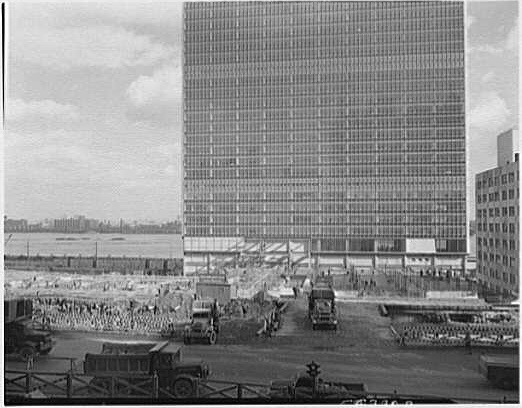 Visual study 02
1950 photograph of the United Nations office building
Study the source before reading the analysis
The unfinished complex is a useful metaphor only if the evidence stays precise: states were investing in a new institution while its membership, authority, and Cold War limits were still developing.
Which claims does active construction support, and which claims about international cooperation would be too strong?